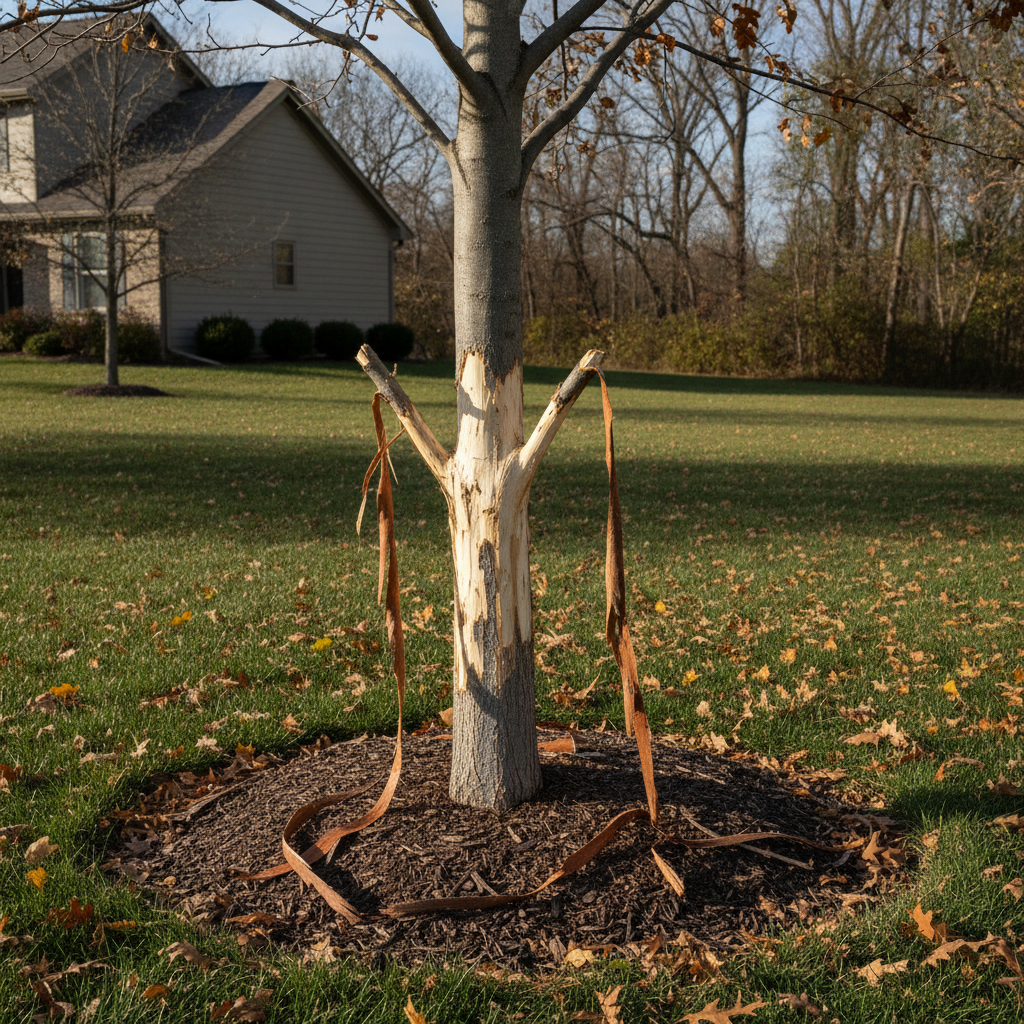
You planted the tree two springs ago. This morning the bottom three feet of the trunk is stripped, the bark hangs in ragged vertical strips, and a few low branches are snapped. Nothing chewed it, nothing bored into it, and no spray will fix it. A buck rubbed his antlers on it, and in northeast Kansas that happens on a schedule you can almost mark on a calendar.
The damage matters more than it looks like it should. The living tissue a deer tears off is the layer that moves water and sugar up and down the stem, so a rub that wraps far enough around the trunk can end the tree even though every leaf looked fine in September. If the trunk on your lot is already open and you want someone to look at whether it’s worth keeping, call (785) 333-4052 and we’ll get an insured provider out.
Why are bucks doing this right now?
Rut timing isn’t weather, and it isn’t luck. K-State Research and Extension’s Johnson County office states the mechanism directly in its article Deer Season in Kansas City: “Biology dictates that deer mate at the same time every year based on change in length of day (photoperiodism).” The same article puts the peak of breeding close to November 15 in the Midwest, with movement climbing in the week or two before that.
So the weeks on either side of Halloween are the front edge of it. Bucks are rubbing to strip velvet, mark territory and work off aggression, and they pick stems that push back. That is the part homeowners miss: the deer is not browsing your tree for food. It’s using the trunk as a tool, and a smooth young stem that flexes is a better tool than a rough mature one.
Kansas Forest Service says what this does to the tree in one line, on its page Protecting Seedlings from Animal Damage: “Bucks rubbing their antlers against trunks may strip bark or completely kill trees.”
What does buck rub damage actually look like?
It reads differently from the other bark problems we get calls about here.
A rub is low, usually between knee and chest height, and it runs up and down the stem rather than around it. The bark is shredded and frayed rather than split cleanly. You’ll often find the torn strips still attached at one end, or lying in the mulch ring. Small side branches at that height get broken off. There’s no sawdust, no exit holes, no ooze.
That’s what separates it from a long clean vertical split on the sunny side of a trunk, which is winter injury and a different problem with a different fix. We wrote that one up separately in split bark on a Topeka tree. It also isn’t a fungus: if you’re looking at shelf growth or soft punky wood, start with fungus on a tree trunk instead.
K-State’s statewide guide Tree and Shrub Problems in Kansas lists it under animal damage: “Male deer rub antlers on trees and shrubs, breaking branches and damaging bark.” The same section explains why the wound is the real issue, not the looks. “Animals cause physical injury to trees and shrubs by weakening the plant and providing entry sites for plant pathogens.”
Can a rubbed tree recover?
Sometimes, and the honest answer depends on how far around the trunk the bark is gone. A narrow strip on one face can close over. A wound that runs most of the way around cuts the pipeline in both directions, and the tree can leaf out next spring on stored energy and still fail later.
The Johnson County extension office is blunt about the usual outcome. In Protecting Against Deer Damaged Trees it writes that bucks rub their antlers on young trees, “causing extensive damage to the bark, which often results in a slow death for the tree.” Then: “Once the damage is done, there is little that can be done to repair the tree. Most times, the tree will need to be removed.”
Read that as one office’s recommendation about young trees, not a verdict on the specific tree in your yard. What we can tell you is the thing not to do: don’t paint it, don’t wrap the wound, and don’t cut the torn bark back on a guess. Leave it alone, and get eyes on the trunk before you decide. A tree health assessment is the right call when the tree is worth money to you and the wound looks like it wraps. If the answer comes back that the stem is finished, tree removal is the next conversation, and taking a small tree out now is a far smaller job than taking a dead one out in three years.
Two related pieces help you read the tree yourself over the winter: how to tell if a tree is dead and tree risk assessment.
Which trees need protecting?
Size is the usable rule here, not species. Johnson County extension recommends protecting “all trees, deciduous and evergreen, under 6 to 8 inches in trunk diameter.”
That covers almost everything planted in the last decade on a typical lot, plus the evergreens people put in as screening along a fence line. We won’t tell you which species are most common in Topeka yards, because no Kansas source we’ve read publishes that census. What we will say is that anything you installed this fall is on the list. If you just planted, the piece on when to plant trees in Topeka covers the rest of that first year.
Deer pressure is also not even across the metro. Lots that back onto creek corridors, the Kansas River bottoms, Shunga Creek, Perry Lake and the wooded edges out toward Perry and Oskaloosa see more of this than a tight block inside the city grid. If you’re on one of those edges, treat it as an annual chore and not a one-time emergency.
What actually stops a buck from rubbing?
Kansas Forest Service puts exclusion at the top: “The most effective method to prevent deer damage is to exclude them entirely.” In practice, on a yard tree, that means a physical barrier the deer can’t reach past.
A rigid fence around the tree. Johnson County extension describes the setup in detail: three to four heavy-duty metal fence posts driven into the ground, then woven wire or concrete reinforcing wire wrapped around them. Placement differs by tree type. “Drive them into the ground at the dripline of the evergreen tree. For deciduous trees, put them 2 feet or more from the trunk.” The posts earn their keep even bare: “The fence posts provide a rigid object for the deer to rub against.” The buck gets his post, your tree keeps its bark.
Tubes and cylinders. Kansas Forest Service describes polyethylene tree tubes for seedlings: “Five-foot polyethylene tree tubes protect seedlings from deer browsing and rubbing while allowing sufficient light for growth.” Note the limit the same page attaches to them: “Not recommended for shrubs or evergreen seedlings.” For wire cages, there’s a warning you have to honor or you trade one problem for another. “Cages must eventually be removed to prevent girdling.” That’s the same mechanism we cover in girdling roots, just applied above ground.
Wraps, with a caveat. Johnson County extension says corrugated plastic tubing is a good option and paper wrap is less effective because deer wear through it, but adds the caution plainly: “the friction caused by heavy rubbing can rip the bark.” Wrap from the base up to the lowest branches, and then remember the date. “Be sure to remove the wrap in late winter/early spring before the tree leafs out.”
Repellents, last. They’re the least dependable tool in the box. Johnson County extension puts it plainly: “Deer repellents are usually not effective because they wear off with rain and snow.” They “should be applied at least once a month, or after every rainfall starting from early fall till late winter.” Sharon Ashworth, Horticulture and Natural Resources Agent for K-State Research and Extension in Douglas County, adds the application conditions in Landscape Protection from Wildlife this Winter: “During fall and winter, apply contact repellents on dry days when temperatures are above freezing.” On a big tree she suggests spending the effort where it counts. “Treat young trees thoroughly, but for larger trees it is more economical to treat the tips of branches within reach of deer (about 6 feet above ground).”
Her summary of the physical options is the one to work from: “Tubes, wraps, wire fencing, and wire cylinders can be placed seasonally around individual trees and shrubs to prevent deer from browsing.”
Frequently asked questions
Will the bark grow back over a buck rub?
Bark doesn’t regrow across the wound the way skin does. The tree closes a wound from the edges inward, over years, and only if enough living tissue is left on either side. A narrow rub can close. A wound that runs most of the way around the trunk usually doesn’t, and that tree may decline slowly over several seasons.
Should I cut off the hanging strips of bark?
Not on a guess, and not with a utility knife in October. Torn bark that’s still attached can sometimes stay connected to living tissue. Have someone look at the trunk before anything gets trimmed back, because a bad cut widens the wound permanently.
Is it too late to protect my trees this year?
No. The weeks before the mid-November breeding peak are exactly when the barrier needs to be up, so putting posts, wire or tubes in this week is useful work, not late work. Repellents need to go on a dry day above freezing, so watch the forecast rather than the calendar.
Does the damage mean the tree has to come out?
Not automatically. It depends on how much of the trunk circumference lost bark, where the wound sits, and what’s underneath the tree if it fails. That’s a judgment somebody makes standing next to the trunk, not from a photo.
Do deer rub evergreens too?
Yes. Johnson County extension’s recommendation covers both, deciduous and evergreen, under 6 to 8 inches in trunk diameter, and screening evergreens along a fence line are a common target. Kansas Forest Service notes that polyethylene tubes are not recommended for evergreen seedlings, so fencing or caging is the better route there.
When to call us
Call (785) 333-4052 if the bark is gone from more than a narrow strip, if the rub is on a tree you’d miss, or if the stem now leans or has lost its top. We’ll match you with an independent insured provider who works Shawnee, Jefferson, Jackson, Osage and Wabaunsee counties, including Perry and the wooded lots north and east of town. For a trunk you want assessed rather than touched, start with an arborist consultation and go from there.