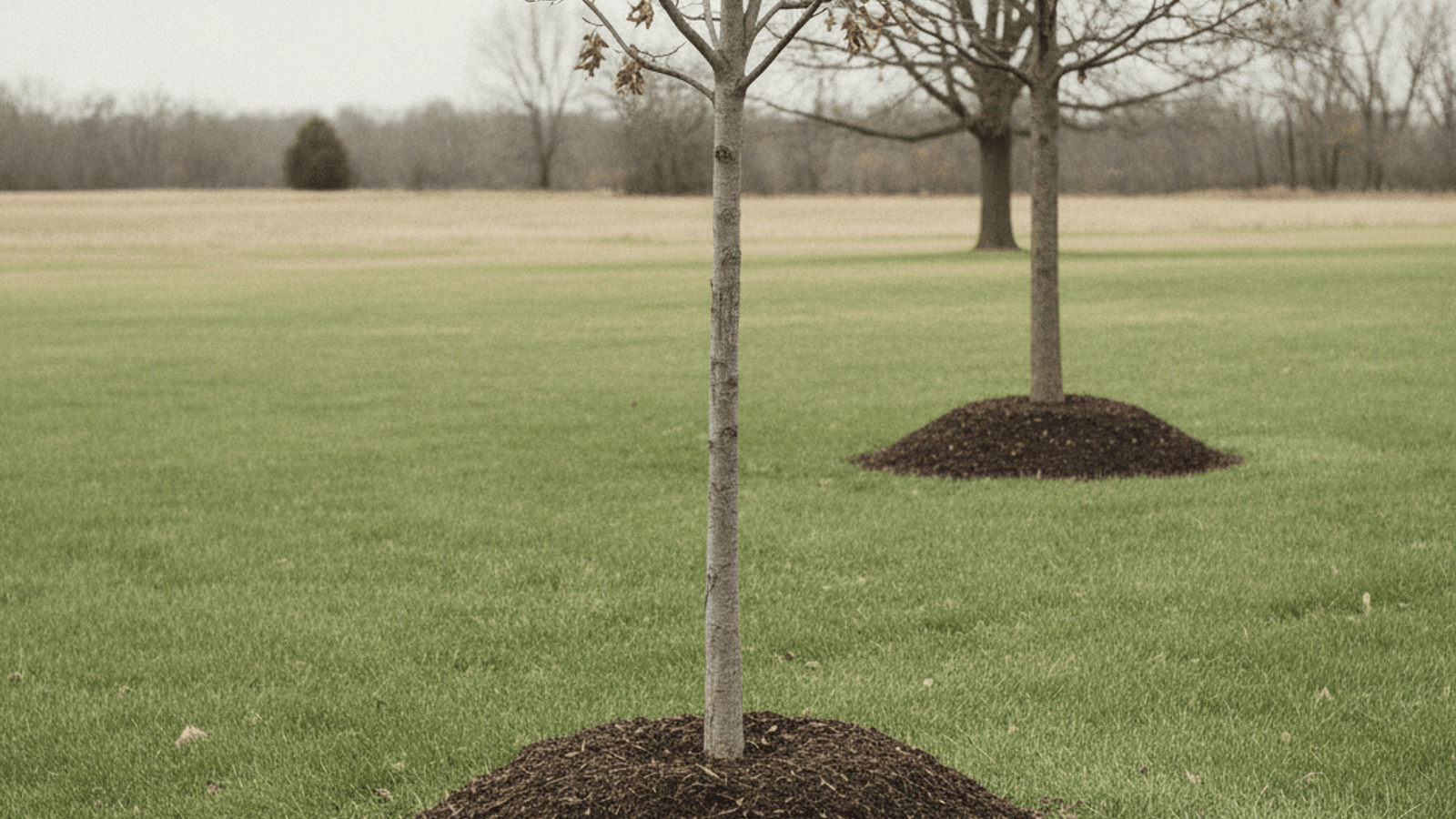
The mulch truck came in October, the crew spread it, and the tree now sits in the middle of a cone of shredded hardwood piled a foot up the trunk. It looks finished. It looks cared for. It is the single most common way a healthy young tree in a Topeka yard gets killed slowly, over about a decade, by someone who was trying to help.
Arborists call that pile a mulch volcano. The problem is not the mulch, which trees genuinely need here. The problem is where it is touching. If you want someone to look at a trunk that has been buried for years and tell you what is going on under there, call (785) 333-4052 and we’ll get an insured provider out.
What is a mulch volcano?
It’s mulch mounded into a cone against the trunk instead of spread flat over the root zone. Markis Hill, Horticulture Ornamentals and Turf Agent for K-State Research and Extension in Johnson County, describes the scale of it in his article Mulch Volcanoes: “Pick any neighborhood in the metro. Drive down the road and look at the street trees on either side. Chances are, you will see a giant pile of mulch at the bases of the trees.”
He goes on: “It is so widespread that someone uninformed of tree care might start to think this is the normal way to mulch the base of trees.” His verdict on the reasons people give for it is short. “It doesn’t matter what the reasons are because it’s wrong.”
That is one Kansas extension office writing about the Kansas City suburbs, not a measured count of Topeka yards. We won’t tell you what share of trees in Shawnee County are mulched this way, because no Kansas source we’ve read publishes that number. Walk your own block in November, though, and you’ll recognize the shape.
The right shape has a hole in the middle. K-State Research and Extension’s Johnson County office puts it in food terms in How to Mulch Trees, comparing a mulch ring to “donuts and bagels. What is in the center of these breakfast foods? A hole! This hole in the center is where the tree trunk would be located.” Hill lands in the same place from the other direction: “The finished shape of your mulching efforts should resemble a flat doughnut.”
What does the pile actually do to the tree?
Four things, and they stack. None of them show up the year you make the mistake, which is exactly why the practice survives.
It holds water against bark that was never built to stay wet. Hill writes: “Mulch against the trunk of the tree can lock in moisture.” He then puts it in disease terms. “A conducive environment, a virulent pathogen, and a susceptible host are the three factors that make up the plant disease triangle. That means when all three are present, it’s just a matter of time before disease infects the plant.” On the spores, he’s blunt that you can’t see them coming. “There is no telling what spores are located in the mulch or what spores can blow in from the surrounding area, but you can bet they are present.” If you’re already looking at something growing on a buried trunk, start with fungus on a tree trunk.
It shuts off air and water. Hill: “If the mulch is too thick, water infiltration and oxygen availability also become issues. As mulch breaks down, it will become compacted and hydrophobic.” Hydrophobic means the pile starts shedding rain instead of soaking it up, which is a real problem in a climate that hands us a hot dry late summer and then expects the tree to go into winter with water in it. Matt McKernan, a Kansas State University horticulture expert, gives the depth limit in a K-State news story from August 25, 2026, Mulch rings help to promote healthy trees: “If mulch is applied too deep (more than four inches), the mulch can actually restrict oxygen from the soil and negatively affect the tree’s root development”, he said.
It invites the roots up into the pile, where they strangle the trunk. This is the one that does the killing. Hill: “This can lead the tree to grow additional roots into the mulch for water and air. Since the mulch is now hydrophobic, the roots might not find any water and could dry out.” Then the worse outcome. “Roots searching for resources could lead to another issue as well. Stem girdling roots. When roots grow close to the trunk and proceed to wrap around the trunk, they increase in diameter along with the trunk. This simultaneous expansion leads to the roots cutting off the vascular system to the stem.” We cover that failure in depth in girdling roots, and it is worth reading if your tree has been mounded for more than a few seasons.
It stacks stress until insects notice. Hill ties the whole chain together: “If the tree is experiencing a lack of water, lack of oxygen, mouse chewing, and some disease pressure, those all contribute to the stress the tree is facing. This stress signals insects who want to feed on the tree. The best defense against insects is for the trees to remain healthy. What isn’t healthy for trees? Heaps of mulch piled at the base of the tree.”
The Johnson County office states the outcome plainly. “Mulch heaped onto the trunk of the tree will result in a shortened life expectancy, or even death.”
How deep should mulch be, and how far from the trunk?
Two Kansas sources agree on the depth and give slightly different numbers for the gap, so here are both.
On depth, the Johnson County office writes that “The thickness of the mulch layer should be somewhere between 2 and 4 inches deep, or thick.” McKernan says the same thing with the maintenance attached: “The mulch should be 2-4 inches deep and re-applied annually.”
On the gap at the trunk, the Johnson County office says “Proper tree mulching starts out about 3 to 6 inches from the trunk”, and the ring runs outward from there. McKernan frames it as a hard line rather than a measurement: “It’s also critical that mulch is never applied against the trunk or covering the root flare of the tree. In these scenarios, mulch may do more harm than good for the tree’s health.”
The root flare is the part to find. It’s the spot where the trunk widens out and meets the soil, and on a correctly planted tree you can see it. Hill uses it as the test: “Mature trees should have a well-defined and visible root flare or where the tree meets the soil. Young trees might not have a well-defined root flare and might need to have the mulch pulled away from the tree trunk.” If you cannot see a flare on a tree that has been in the ground ten years, something is buried, and that is the thing to get looked at.
On how wide the ring should be, the Johnson County office says a ring “continues out in all directions at least 3 feet. Six feet would be even better for long-term establishment and increased growth.” McKernan gives a diameter instead: “The mulch ring around trees in a lawn should be at least 3-6 feet in diameter depending on the overall size of the tree,” and adds the ideal. “Ideally, the mulch ring should extend to the drip line of the tree, which means the ground beneath the entire canopy of the tree should be covered. This is not always practical, but the larger the mulch ring, the more the tree will benefit.”
Read those as two recommendations using two different measurements, a radius and a diameter, not as a contradiction to resolve. Wider is better in both.
Why bother with a mulch ring at all?
Because of what the mower does. McKernan names that as the headline benefit: “Mulch rings will benefit trees of any size, however, one of the greatest benefits of using a mulch ring around trees in a lawn area is to prevent maintenance equipment from coming too close and damaging the trunk”, he said. His summary of the payoff: “This little change can make a big difference in the overall growth and health of the tree.”
That matters more in northeast Kansas than people expect. Our mature canopy is largely fast-growing shade trees with thin young bark on the replacement plantings underneath, and a string trimmer run around a bare trunk every ten days all summer does the same kind of damage a buck does in November. A flat ring keeps the blade and the line out of range without putting anything against the bark.
If you’re planting this fall, build the ring correctly the first time instead of fixing it later. When to plant trees in Topeka covers the timing, and tree planting cost in Topeka covers what the job runs.
What mulch should I use, and what about the leaves?
The Johnson County office is relaxed about the product and specific about the material. “The best mulch for trees is organic wood chips. There are a number of different wood chip products which all accomplish the desired outcome of improved tree growth.” On the premium stuff at the garden center, it is unsentimental: “Raked leaves are just as effective as the trendiest designer dyed mulch on the market.”
That is useful in late October here, when every yard in the city is producing the raw material for free. Our piece on fall leaf cleanup in Topeka walks through handling the volume, and tree debris disposal covers what to do with chips and limbs when a job leaves more than a ring’s worth behind.
How do I fix a tree that’s already buried?
Pull the mulch back and look, then decide based on what you find.
The Johnson County office describes the yearly maintenance as exactly this motion: “Start by carefully pulling the mulch back from the trunk, and then add enough new mulch to the 4 inch depth.” Uncover the flare, get the pile off the bark, and spread what you removed out across the ring rather than hauling it away.
What you find under there changes the next step. Sound bark and a visible flare means you just fixed it. Soft or missing bark, or roots running in circles around the stem, is a different conversation, and Hill draws the line by tree age: “Stem girdling roots can be corrected on a young tree. Big mature trees, on the other hand, cannot be corrected.”
We’re not going to tell you to cut roots or remove a tree we haven’t seen. If the trunk has been buried for years and the tree is worth money to you, a tree health assessment puts eyes on the flare, and an arborist consultation is the right call when you need the decision written down. If you’re trying to read the tree yourself over the winter first, how to tell if a tree is dead is the place to start.
Frequently asked questions
Is mulch bad for trees?
No. Mulch piled against the trunk is bad for trees. K-State Research and Extension’s Johnson County office recommends a ring of organic wood chips 2 to 4 inches deep, starting 3 to 6 inches out from the trunk and extending at least 3 feet in all directions, and K-State’s Matt McKernan recommends re-applying it annually.
How deep should mulch be around a tree in Kansas?
Between 2 and 4 inches. McKernan warns that “If mulch is applied too deep (more than four inches), the mulch can actually restrict oxygen from the soil and negatively affect the tree’s root development”, he said.
Will removing a mulch volcano save my tree?
It depends on what the pile has already done, and nobody can answer that without seeing the trunk. If the bark is sound and the root flare is intact, clearing the pile removes the cause. If circling roots have formed, Markis Hill of K-State Johnson County notes those can be corrected on a young tree but not on a big mature one.
When should I mulch trees in Topeka?
Both K-State sources describe mulching as yearly maintenance rather than a seasonal task, and neither names a month. Fall is a practical time here because the leaves are free and the ring is easy to see before the ground freezes. The depth and the gap matter more than the date.
Why do landscapers keep building mulch volcanoes?
Hill addresses that directly and declines to engage with the justifications: “There are several reasons why people and companies have their motivations and justifications. It doesn’t matter what the reasons are because it’s wrong.”
Getting someone out to look
A buried trunk is one of the few tree problems you can fix yourself in an afternoon with a rake, as long as what’s underneath is still sound. The part you can’t do from the driveway is judging whether a decade under a pile has already cost the tree its vascular connection.
If you’ve got a mature tree with no visible flare, a lean that showed up without a storm, or thinning in the upper canopy on a tree that’s been mounded for years, get it looked at before spring. Call (785) 333-4052 and we’ll connect you with an insured local provider serving Shawnee, Jefferson, Jackson, Osage and Wabaunsee counties.