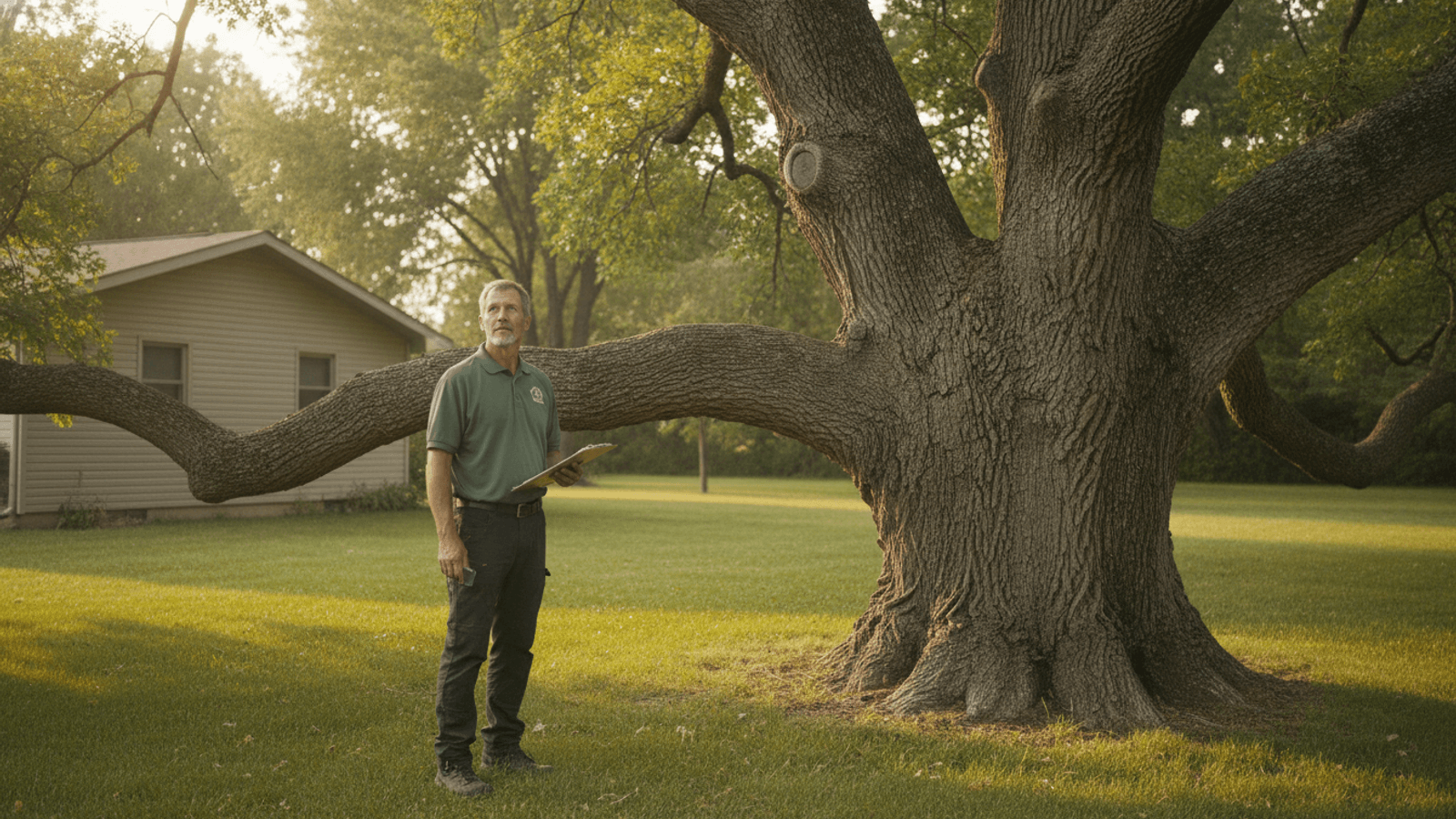
A tree risk assessment in Topeka considers three separate things: how likely a specific part is to fail, how likely it is to strike a target, and what the consequences could be. A qualified assessor combines those inputs into a risk rating for the stated assessment period. Before booking, ask whether the service includes a written report, its limitations, and a reassessment recommendation.
That structure matters because it explains the result homeowners find hardest to believe. A hollow, half-dead tree in a back corner can rate low, while a tree that looks fine over your driveway rates higher. The tree’s condition is only one of the three inputs.
What is a tree risk assessment in Topeka, and what do you actually get?
A written report should identify the tree, inspection date, risk rating, recommendations, and stated assessment period. Confirm that this deliverable is included in the quoted scope. The International Society of Arboriculture’s Basic Tree Risk Assessment Form is used to collect and analyze assessment data, but the form alone is not the finished report.
Worth knowing before you pay: ISA states plainly that the form by itself is not the report. In ISA’s words, “The Form alone is not intended to serve as a report.” A properly done assessment attaches the data collection to a written document that interprets it. If someone hands you a filled-in checklist and calls it done, you got the worksheet, not the deliverable.
A complete report covers the rating, what could be done to lower it, what risk would remain after that work, and when the tree should be looked at again. It also lists what the assessor could not see. That last part is the honesty check on the whole document, and we come back to it below.
How does an arborist turn a defect into a risk rating?
Through two matrices, in a fixed order. The assessor doesn’t score the tree on a gut feeling.
The first matrix combines likelihood of failure with likelihood of impacting a target. Likelihood of failure gets one of four categories: improbable, possible, probable, or imminent. Likelihood of impact gets very low, low, medium, or high. The output is a combined likelihood: unlikely, somewhat likely, likely, or very likely.
The second matrix takes that combined likelihood and crosses it with consequences of failure, rated negligible, minor, significant, or severe. The result is the risk rating you actually hear about: low, moderate, high, or extreme.
Two behaviors of those matrices are worth understanding, because they drive most of the surprising results.
An improbable failure lands on “unlikely” no matter what it would hit. Every single cell in that row comes out unlikely. And a combined likelihood of “unlikely” produces a low risk rating no matter how severe the consequences would be. So a tree that genuinely isn’t going to come apart this year rates low even if a house sits under it.
The other direction holds too. To reach an extreme rating, the recorded inputs must support an imminent failure, a high likelihood of impact, and severe consequences together. Ask the assessor to show how the observed conditions and targets support any rating.
One more mechanic that catches people: when an assessor finds several possible failure types on one tree, the overall rating is the highest one found, not an average. A bur oak with three minor concerns and one serious one is rated on the serious one. If you’ve read our guide to when a split bur oak can be cabled instead of removed, this is the machinery behind that judgment call.
Why can a healthy-looking tree rate higher than a hollow one?
Because two of the three inputs are about what’s underneath the tree, not the tree itself.
The assessment records a target zone for each thing that could get hit. The options are the drip line, one times the tree’s height, one and a half times the height, or beyond that. One times height is the standard striking distance if the trunk or roots fail. The one-and-a-half figure exists for a specific reason: dead or brittle branches can shatter and fly on impact, carrying debris further than the trunk itself reaches.
Then it records an occupancy rate, meaning how much of the time that target is actually there. ISA’s four categories are rare, occasional, frequent, and constant. Constant means a target is present nearly all the time, 24 hours a day, 7 days a week. A house qualifies. A patio chair nobody sits in does not.
Put those together and the arithmetic gets clear. A decayed cottonwood at the back of an acre, with nothing inside a target zone and rare occupancy, produces a low likelihood of impact and often negligible consequences. A structurally sound silver maple with one overextended limb above a spot where kids wait for the bus produces high impact likelihood and significant consequences from a much smaller defect.
This is also why the assessor asks about your habits. Where you park, where the dog runs, whether anyone sits under the tree in summer. Those aren’t small talk, they set the occupancy rate.
Which level of assessment does your tree need?
There are three, and they cost different amounts because they involve different work.
Level 1 is a limited visual assessment. It’s a fast look at many trees from a defined vantage point, built to flag the obvious and urgent ones. Cities and campuses use it to triage a whole population. It’s the wrong tool for one questionable tree in your yard.
Level 2 is a basic assessment. This is the standard engagement for a homeowner: a walk-around inspection of the whole tree, ground to crown, with the data recorded and analyzed. The ISA Basic Tree Risk Assessment Form is built for exactly this level.
Level 3 is an advanced assessment. It brings diagnostic work beyond what the eye can settle, and it’s recommended when a basic assessment can’t answer the question. On the ISA form there’s a field for this. The assessor marks the data either “final,” meaning they collected enough to make a reasoned judgment, or “preliminary,” meaning an advanced assessment is recommended before anyone decides anything.
If your report comes back marked preliminary, the job isn’t finished. That’s not the assessor hedging, it’s the form working as designed.
What credential should the person holding the clipboard have?
There are two separate things to ask about, and most homeowners only know about one.
ISA Certified Arborist is a broad professional credential. It requires tested knowledge and continuing education, and the certification program carries a code of ethics. The Kansas Forest Service points homeowners toward this credential. When arranging an arborist consultation, ask who will perform the assessment and which current credentials that person holds.
ISA Tree Risk Assessment Qualification, usually written TRAQ, is the specific one for this job. It’s a separate program layered on top, and the requirements are not trivial. The standard course runs two days in person followed by a half-day examination. The written exam is 110 multiple-choice questions in two hours, needing 75 percent to pass, and there’s a second, performance-based exam where the candidate assesses an actual tree outdoors under an evaluator. The coursework covers nine modules, including target assessment, data analysis and risk categorization, mitigation, and reporting.
Two honest caveats on TRAQ, both straight from ISA’s own program guide. The qualification is valid for seven years, after which the holder has to retrain and retest, with no extension past the expiration date. And unlike the certification, ISA states that its qualifications “are not subject to ongoing requirements, such as adherence to a code of ethics or participation in continuing education activities.”
So the useful question isn’t “are you certified.” It’s whether the person rating your tree holds TRAQ, whether it’s current, and whether they also hold the certification that carries the ethics obligation. Ask for both.
Neither one is a government license. ISA is explicit that its qualifications “do not represent licensure, registration, or other authorization to practice.” For regulated tree work within Topeka, the city code requires tree businesses to be licensed. Ask a provider to confirm current city license status, relevant ISA credentials, and insurance coverage. Our Topeka tree removal permit and licensing guide explains the local checks.
For work that’s headed toward a dispute rather than a decision, there’s a third tier. The American Society of Consulting Arborists registers consulting arborists whose training centers on independent written opinions and report writing, which is the skill set that matters when a report has to hold up in front of someone who disagrees with it.
When is a cost estimate enough, and when do you need a risk report?
A cost estimate and a risk assessment are different products, and confusing them costs people money in both directions.
A cost estimate prices a proposed scope. It can be useful when you already know which work you want priced. Topeka Tree Pro can connect Greater Topeka homeowners with independent insured providers for a tree removal or trimming estimate. Ask what the written quote includes and whether any diagnostic report is separate.
A risk assessment serves a different purpose. It documents a qualified opinion about the tree, targets, inspection limitations, and possible risk-reduction steps. Consider one when another party needs written information, such as an insurer, HOA, city office, buyer, or neighbor. Confirm that party’s documentation requirements before ordering the assessment.
If you’re on the board or managing the property rather than owning the one tree, the assessment usually feeds a bigger document. Our guide to what a commercial tree service bid should require in Topeka covers how a rating turns into a written scope and which insurance certificates to collect before a crew starts.
If an insurance question is involved, check the policy and ask the insurer what documentation it requires. Our guide to whether homeowners insurance covers tree removal in Topeka outlines questions to raise. A dated professional assessment and records of completed work may help document what was known and addressed, but they do not guarantee coverage or resolve liability.
Our tree health assessment service covers the diagnostic side when the question is whether a tree is declining. The risk report is the document you commission when the question is what happens if it fails.
What the report should say before you pay for it
Four things beyond the rating. Check for all four.
Mitigation options. Not just a rating, but what could be done about it. ISA’s example wording is instructive because it’s this specific: “prune to remove dead branches throughout the crown and reduce the length of the overextended branch over the house by one-third.” Removal is one option on a list, not the default answer.
Residual risk. What the risk would be after the recommended work. It gets rated the same way, and there’s a rule attached: a residual risk of “none” should only be applied when the tree is recommended for complete removal. Any report telling you that pruning takes the risk to zero is misusing the term. Cabling and bracing work is a good example, since it reduces risk without eliminating it.
A reassessment interval. The form has a field for how long until the tree should be looked at again, and the assessment itself is defined for a stated time frame, typically between one and five years. A risk assessment is a snapshot with a shelf life. A three-year-old report on a declining tree is a historical document.
Inspection limitations. What the assessor couldn’t see. The standard categories are visibility, access, vines, and a buried root collar, and that last one matters more than it sounds, because turf, mulch, and pavement over the root flare hide the part of the tree where a lot of serious decay starts. A report claiming a clean look at everything, on a tree with a mulch volcano at the base, is overselling itself.
What should a Topeka assessment account for that a national checklist won’t?
Wind and ice, the local species mix, and recent changes to the site.
The ISA form records wind exposure as protected, partial, full, or funneling, and funneling is the one that gets overlooked here. Wind gets channeled by buildings and gaps toward a specific tree, so a tree at the corner of a house can carry a much higher load than a neighbor’s tree fifty feet away. In Tornado Alley that distinction is doing real work. The same goes for ice, which loads a crown in a way summer wind never does, as our guide to ice storm tree damage in Topeka covers.
The form also records site changes, specifically grade changes, site clearing, and altered hydrology. Site clearing is the sleeper: when neighboring trees that used to block wind come out, a tree that was sheltered its whole life is suddenly fully exposed without having grown any wood to handle it. New construction next door can change a tree’s risk rating without anyone touching the tree.
Species can affect what an assessor examines, but a species name does not establish a tree’s condition or risk rating. Dead wood, branch unions, codominant stems, site conditions, and nearby targets require individual inspection. For related background, see our guides to emerald ash borer in Shawnee County and Bradford pear splitting.
Public forestry programs and private tree assessments serve different purposes. For a tree on public property or city right-of-way, ask the Division of Forestry what review or permit applies. For a private tree, ask an independent provider which assessment level and written deliverables are available for the actual situation.
Topeka Tree Pro connects homeowners across Shawnee, Jefferson, Jackson, Osage, and Wabaunsee counties with independent insured tree-service providers, from in-town lots to acreage near Rossville and Auburn. Ask about assessor qualifications, written scope, availability, and whether the person preparing a risk report holds current relevant credentials. Call (785) 333-4052 and explain whether you need a work estimate or a written assessment.
Frequently asked questions
How much does a tree risk assessment cost in Topeka?
The fee depends on the number of trees, assessment level, access, report detail, and whether advanced testing or dispute-ready documentation is requested. Ask each provider whether the quoted amount includes the site visit, written report, inspection limitations, photos, and follow-up recommendations. The provider must review the actual scope before pricing it.
How long is a tree risk assessment good for?
The assessment is defined for a stated time frame, typically between one and five years, and the report should name a reassessment interval. Beyond that window it documents what the tree was, not what it is. Any significant event resets the clock early. A major wind or ice storm, construction near the root zone, or the removal of neighboring trees all change the inputs enough that the old rating no longer applies. Sidewalk work belongs on that list as well, since cutting buttress roots to reset a lifted panel can move a tree’s stability rating on its own. Our guide to tree roots lifting a Topeka sidewalk covers the trunk-diameter distances where that starts to matter.
Is a tree risk assessment the same thing as a removal estimate?
No. A cost estimate prices work a crew is proposing to do. A risk assessment is a professional judgment that produces a written document with a rating, mitigation options, and residual risk. The estimate answers what it costs. The assessment answers whether it needs doing and what happens if you wait.
Can a tree risk assessment prove I wasn’t negligent?
No. A tree risk assessment cannot prove that you were not negligent or guarantee an insurance or legal outcome. A dated assessment and records of completed work may document what was observed and addressed at the time. Ask the insurer or a qualified attorney how that information applies to a specific dispute.
Does a low risk rating mean the tree is safe?
It means the combination of failure odds, impact odds, and consequences came out low on the date of the inspection, within the limitations the report lists. It isn’t a guarantee. Trees are living structures in changing conditions, and a rating is a considered judgment rather than a certainty. That’s also why the reassessment interval exists.
Do I need a TRAQ-qualified arborist, or is a Certified Arborist enough?
For a risk assessment specifically, TRAQ is the qualification built for the task, and it’s reasonable to ask for it. ISA Certified Arborist is the broader competency credential and carries the code of ethics that the qualification does not. Many professionals hold both. Ask which ones apply and whether the TRAQ is current, since it expires after seven years and requires retraining and retesting to reinstate.
Will the City of Topeka accept an arborist’s report?
ISA notes that some municipalities require the assessment form to be submitted with permit applications, so a documented arborist report is a recognized instrument. Whether Topeka requires one for your particular situation depends on the tree and the work, and the City’s Forestry Division is the office to ask before you commission anything. Our tree removal permit guide covers which jobs need city sign-off in the first place.
Can an assessment recommend something other than removal?
Yes. The mitigation section can list options such as pruning, structural support, restricting access to a target zone, moving a target, or removing the tree. The suitable options depend on the defect, site, targets, and intended result. If removal is recommended, ask why other options are unsuitable and consider getting a second qualified opinion.
Getting the question right before you commission anything
Start by matching the service to the decision. If you want proposed tree work priced, request written estimates that describe the scope. If an adjuster, board, city office, buyer, or neighbor needs a documented professional opinion, ask what kind of assessment and report that party will accept before booking it.
Either way, ask what level of assessment you’re buying, what credentials the assessor holds, whether the written report is included, and when the tree should be looked at again. Four questions, asked before the visit, sort out almost everything else.