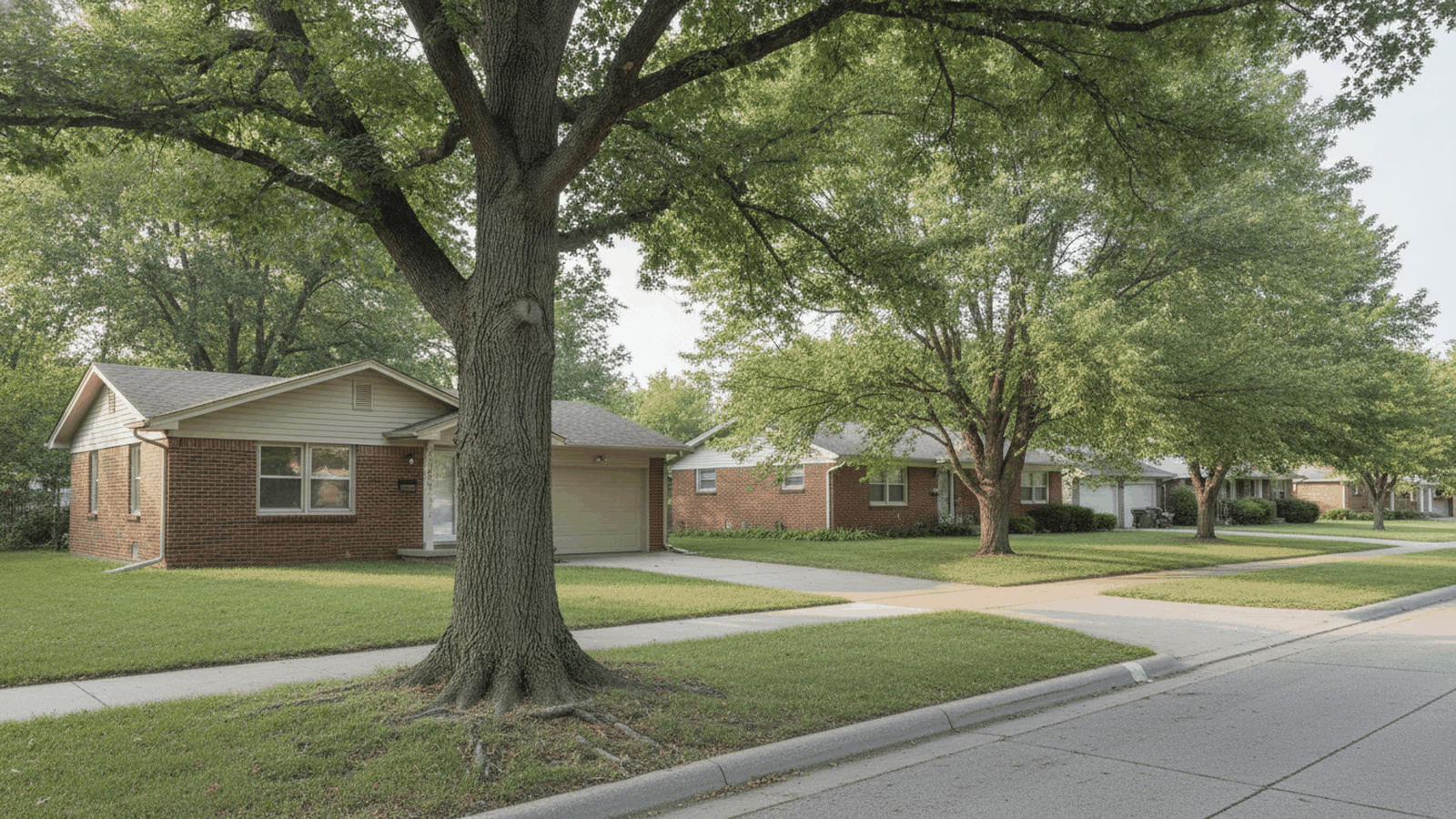
A Topeka tree removal permit is required for listed work on public property, including city-owned land and city right-of-way. The code does not let you decide permit status from a backyard-versus-curb split alone. Confirm ownership, location, and actual circumstances with the Division of Forestry before work starts.
This guide explains the confirmed public-property permit rule, city tree-business licensing, and questions involving boundaries or official notices. Treat it as a starting point, then verify the current rule for the parcel and proposed work.
Does Topeka require a tree removal permit on private property?
Do not rely on a blanket yes-or-no answer without checking the property and proposed work. The confirmed rule in TMC 12.65.030 requires a Division of Forestry permit for listed tree and vegetation work on public property.
First confirm whether any part of the work affects city-owned property or city right-of-way. Then ask the Division of Forestry whether another rule, condition, or permission applies to the actual circumstances. A tree business working within Topeka must also satisfy the city licensing requirement.
What tree work does need a Topeka permit?
TMC 12.65.030(a) is the one to know. It says no person shall “plant, set out, maintain, protect, spray, fertilize, treat, trim, prune or remove any tree, hedge, bush, shrub or vine upon public property” without first getting a permit from the Division of Forestry.
Read that list again. It is not just removal. Trimming and pruning a public tree need the permit too, and so does planting one. The Division of Forestry can issue the permit, issue it with conditions, or deny it outright.
There is also a cleanup clause most people miss. Under 12.65.030(b), the permit can be revoked if the person doing the work fails to remove leaves, trimmings, branches, stumps, trash, or other material from the premises. A crew that leaves your parkway full of brush is not just being sloppy, it is putting the permit at risk. If a permit is denied or revoked, TMC 12.65.030(c) allows an appeal under Chapter 2.45.
The parkway tree is the one that surprises people
The strip between the sidewalk and street may fall within city right-of-way. Its appearance and routine upkeep do not establish the boundary. Confirm the property line and right-of-way before arranging work on a tree near the curb.
A tree near the curb may be affected by the public-property permit rule. Confirm the right-of-way through the appropriate city or property records. If the location remains disputed, ask what formal boundary documentation is needed. An arborist consultation can address tree condition, but it does not replace a property survey or an official ownership decision.
The walk itself is a different question from the tree standing next to it. Under TMC 12.35.010, the sidewalk is the abutting owner’s to repair even though it sits in the same right-of-way. If roots have cracked or tilted a panel, our guide to who pays when tree roots lift a Topeka sidewalk explains the repair duty and the City’s cost-share program.
Who can legally do tree work in Topeka?
Under TMC 5.165.030, anyone engaging in the business of listed tree, shrub, or vine work within Topeka must first obtain a license from the City Clerk. The regulated activities include planting, cutting, trimming, pruning, removing, spraying, or otherwise treating trees, shrubs, or vines. This business-licensing requirement is separate from the public-property permit rule.
The license is not a rubber stamp. TMC 5.165.050 sends every application to the City Forester, who examines the applicant orally, in writing, or both, on their qualifications and competency, and can require a demonstration of practical ability or evidence of previous satisfactory experience. Under TMC 5.165.060 and 5.165.080, the license lists the specific types of service the holder is approved for, and working outside those categories is grounds for revocation.
There is an insurance floor too. TMC 5.165.070 says no license takes effect until the applicant shows the City Clerk a public liability policy of at least $100,000 per person injured, at least $200,000 where two or more people are hurt in one accident, and at least $50,000 for property damage. The policy may carry up to a $500 deductible on property damage. If the policy is cancelled, the carrier has to notify the City within 10 days, and losing the insurance is grounds for suspending or revoking the license.
Those figures are municipal licensing minimums, not proof of any provider’s current policy limits or coverage. Ask for a current certificate and verify the applicable coverage directly. For a larger or commercial scope, use our commercial tree service bids in Topeka guide to organize the questions for each bidder.
How to verify a tree business license
Vehicle markings do not prove whether a business holds a current license. Ask the provider for its business name and license information, then verify the status and approved work with the City Clerk before work begins.
Topeka Tree Pro connects homeowners with independent insured tree-service providers. Homeowners should still verify the matched provider’s current license, insurance, qualifications, and written scope directly.
Licenses, certifications, and treatment qualifications answer different questions. Verify the City of Topeka tree-business license first. Then ask the provider which qualifications apply to the proposed work and where those credentials can be confirmed.
If the job includes emerald ash borer treatment or another chemical application, ask the provider which authorization applies. Verify it with the responsible agency instead of assuming a tree-business license covers treatment work.
When the city can order you to remove a tree
Article II of Chapter 12.65 is the part of Topeka’s tree law with real teeth, and it runs the opposite way from a permit.
TMC 12.65.080(a) makes it the duty of a private property owner abutting a street or alley to remove vegetation located in that street or alley where it impedes travel, as determined by the City Forester.
TMC 12.65.080(b) goes further onto your own land. It makes it your duty to treat or remove trees, tree materials, or shrubs on your property when the City Forester determines they are infected or infested with plant disease, insect pest, or larvae whose uncontrolled presence may damage or destroy other trees in the community. That is the clause that matters for the two diseases already moving through this area, so it is worth reading alongside our guides to emerald ash borer in Shawnee County and Dutch elm disease in Kansas.
The enforcement path is spelled out. Under TMC 12.65.090 the City Forester issues a written notice to abate. TMC 12.65.100 says that notice has to state the location of the hazard, describe it, list the acts needed to abate it, and warn that failure to act can bring prosecution or city abatement. Service can be by first class mail with proof of mailing, certified mail, or personal service under TMC 12.65.110, and can be published in the official city newspaper when the owner is unknown or a nonresident.
If you do not act, TMC 12.65.120 lets the City Forester abate the hazard, and TMC 12.65.130 allows the costs to be assessed against the property under Chapter 3.45, Article III. If you receive an official notice, read the required actions and response instructions carefully. Ask the city about the applicable process, then obtain a written tree removal estimate that identifies removal, hauling, stump work, and exclusions. Our tree removal cost guide for Topeka explains how to compare the scope without relying on a general price range.
Trees on the property line: what Kansas law says
Kansas settled the neighbor question in Pierce v. Casady, 11 Kan. App. 2d 23, 711 P.2d 766, decided December 31, 1985. Three holdings from that case answer most boundary disputes.
First, you have the right to trim branches that overhang your property even when the trunk stands on your neighbor’s land. Second, you may not go onto your neighbor’s land and remove the tree or any part of it without permission. Third, Kansas follows the rule that a tree becomes a nuisance only when the overhanging branches do substantial harm or create an imminent danger, not merely because they drop leaves or shade a garden.
Where a tree does qualify as a nuisance, the court said the affected landowner may compel the neighbor to abate it, or if an injury occurs, look to the neighbor for damages allowable by law. The court also noted the flip side: the tree’s owner has no right to enter the neighbor’s property or use the neighbor’s airspace to cable or brace the tree. If someone crossed that line and the tree is already gone, valuing it is a separate question with its own Kansas answer, covered in what a tree is worth after a neighbor cuts it down.
That last point has a practical consequence. If the fix for a leaning boundary tree is cabling and bracing rather than removal, and the hardware would have to be installed over the neighbor’s yard, the work needs the neighbor’s cooperation. Sort that out before the crew arrives, not from the bucket.
New construction and lot clearing are a separate rulebook
If you are developing a lot rather than maintaining a yard, Topeka’s landscape chapter applies on top of everything above.
TMC 18.235.070 runs a points system. Preserving an existing significant tree earns credits against the landscape points a development owes, worth 15 points for a tree of six to 12 inches, 20 points for one between 12 and 24 inches D.B.H., and 25 points for one over 24 inches. Removing significant trees works the other way and adds required points at the same tiers. A significant tree that dies during or because of construction must be replaced with a similar species, or one the City Forester approves, to equal or exceed the lost tree’s point value.
D.B.H. is defined in the chapter as diameter at breast height, measured four and a half feet above the ground, and applies to trees over 12 inches in diameter. The Planning Director, consulting the City Forester, may waive some or all of the additional removal points where the removal will not hurt the development’s overall appearance. Anyone planning land and lot clearing inside city limits should price the landscape points into the project, not discover them at plan review. Clearing acreage outside the city is a different rulebook and a different pricing model, and our guide to what land clearing costs around Topeka covers how pasture and fence-line work gets scoped by density instead.
One more construction rule sits in the forestry chapter. TMC 12.65.050 requires anyone building, repairing, altering, or removing a structure to guard public trees from injury, and if a public tree is damaged or destroyed, that person replaces it at their own expense with the City Forester deciding type and size.
Frequently asked questions
Do I need a permit to remove a tree in my Topeka back yard?
Confirm the actual circumstances before work starts. TMC 12.65.030 requires a Division of Forestry permit for listed work on public property. Verify ownership, right-of-way boundaries, and any other applicable requirement with the city. The tree business must also satisfy Topeka’s licensing rule.
Who owns the tree between my sidewalk and the street in Topeka?
Location alone does not settle ownership. The strip may fall within city right-of-way, which is public property for the confirmed permit rule. Check the boundary before scheduling work. If the tree is on public property, listed work requires a Division of Forestry permit under TMC 12.65.030.
Does a tree company need a license to work in Topeka?
Yes. TMC 5.165.030 makes it unlawful to run a tree cutting, trimming, pruning, removal, or spraying business inside the city without a license from the City Clerk. The City Forester examines each applicant’s competency, and the license names the specific service categories the holder may perform.
How much liability insurance must a licensed Topeka tree crew carry?
At least $100,000 for each person injured, $200,000 where two or more people are injured in one accident, and $50,000 for property damage, under TMC 5.165.070. Up to $500 of the property damage liability may be deductible, and the insurer must notify the City within 10 days if the policy is cancelled.
Can the City of Topeka make me remove a diseased tree?
Yes. TMC 12.65.080(b) makes it a property owner’s duty to treat or remove vegetation the City Forester determines is infected or infested with disease, insect pest, or larvae that could damage other trees in the community. The city can issue a notice to abate, do the work itself if you do not, and assess the cost against your property.
Can I cut my neighbor’s branches that hang over my Topeka yard?
Yes, up to the property line. Pierce v. Casady confirmed that a Kansas landowner may trim overhanging branches even though the trunk is on a neighbor’s land, but may not enter the neighbor’s property to remove the tree or any part of it without permission.
How do I verify a Topeka tree business license?
Ask for the provider’s business name and license information. TMC 5.165.030 requires a City Clerk license for the regulated tree-business activities it lists. Verify current status and approved work with the City Clerk before hiring.
Getting the jurisdiction right before the saw starts
Greater Topeka includes more than one jurisdiction. The confirmed City of Topeka rules should not be assumed to govern work in Silver Lake, Rossville, Holton, or unincorporated areas. Ask the authority responsible for the actual property which permits, licenses, or permissions apply.
There is one more layer that has nothing to do with the city or the county. Around Perry Lake, land on the Corps of Engineers side of the project boundary runs on federal rules, where cutting trees or parts of trees needs written permission regardless of what any local code says. Our guide to Corps of Engineers tree removal near Perry Lake covers where that boundary actually sits.
Establish who owns the tree, verify the provider’s license where the work occurs, and get the scope in writing before cutting begins. Topeka Tree Pro connects Greater Topeka homeowners with independent insured tree-service providers. Call (785) 333-4052 to request an estimate, then confirm availability, qualifications, and any estimate or visit fees with the matched provider.
Rules can change. For a specific parcel and proposed scope, confirm the current requirements with the Division of Forestry or City Clerk before work begins.