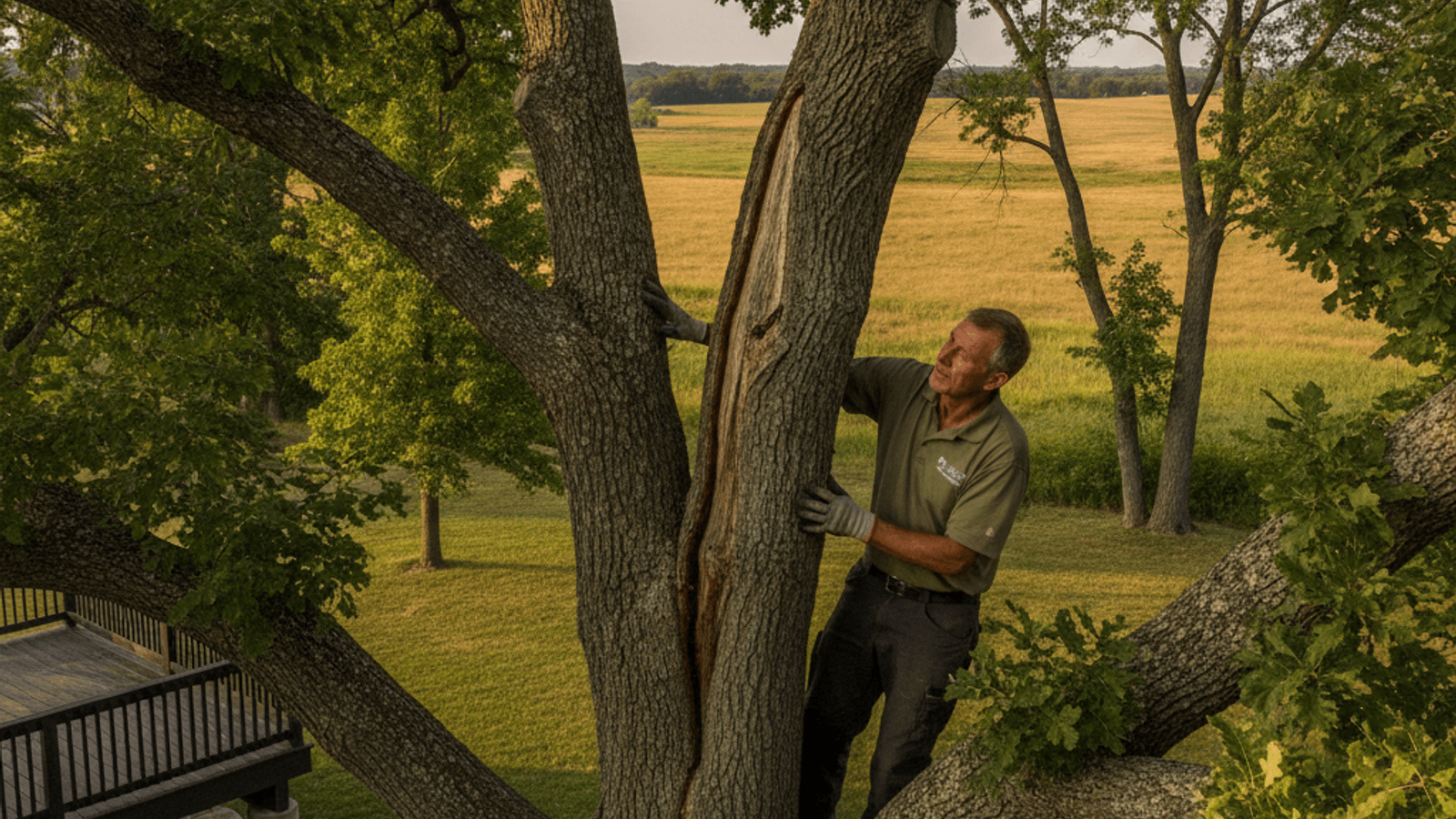
Cabling and bracing vs removal for a split bur oak depends on the individual tree and site. A visible crack does not show whether the surrounding wood, roots, or other unions are sound. Keep clear of unstable damage and ask a qualified provider to assess the structure, obstacles, access, and intended result.
Why bur oaks split at codominant unions
A codominant stem structure happens when two leaders of roughly equal size compete for dominance instead of one clear main trunk taking over early. Instead of a strong, tapering connection, the two stems meet at a narrow angle with a seam of included bark trapped between them, tissue that never fully fuses the way a normal branch union does.
That seam is structurally weaker than the surrounding wood. Under enough load, wind, ice, or just the accumulated weight of decades of growth, it’s the point most likely to crack open first. Once it splits, the two stems can start moving independently instead of as one unit, which widens the crack over time if nothing intervenes.
What makes a good cabling candidate
A provider may consider cabling and bracing after examining the split, surrounding wood, other major unions, trunk, roots, canopy, and nearby targets. No single feature confirms that support is appropriate.
Ask what defect the proposed system addresses, what it cannot correct, and what follow-up inspection the provider recommends. A tree health assessment should also consider soil, drainage, moisture, light, recent disturbance, and other possible causes of decline. Cabling manages movement at selected points; it does not restore damaged wood or guarantee the tree’s future stability.
What makes a tree a poor candidate
Cabling is not appropriate for every damaged tree. Decay near a proposed attachment point, root instability, extensive canopy loss, or several compromised unions may change what can be supported safely. These signs still require professional evaluation because their extent cannot be confirmed from one symptom or a ground-level view.
Tree removal may be recommended when the provider finds that support or pruning cannot manage the identified condition around the home, driveway, utility area, or other target. Ask for the specific findings and alternatives in writing before comparing proposals.
How an assessment actually determines the answer
A tree health assessment should consider more than the visible crack. Ask the provider to evaluate the union, surrounding wood, trunk, roots, canopy, soil conditions, access, nearby obstacles, and the consequences if part of the tree fails. Similar symptoms can have several causes, so the assessment should explain what was observed and what remains uncertain.
A quote describes proposed work and price. A formal assessment may provide a separate written explanation of the condition and recommendation. Ask what document you are buying and what it includes. The guide to tree risk assessment in Topeka explains useful questions to raise before hiring.
What the installation process involves
For trees that are good candidates, cabling typically means installing a steel cable high in the canopy, above the split, connecting the two stems so that if one leans under wind load, the cable limits how far it can move independently. Bracing rods are sometimes added lower at the union itself for extra rigid support, especially where the split has already opened slightly. The whole system is designed to redistribute load rather than lock the tree completely rigid, since some flexibility is actually part of what keeps a tree healthy in wind. Edward F. Gilman of University of Florida IFAS Extension describes that same layout on Cabling and bracing trees: cables typically above a weak union, with rods near or in the union.
This isn’t a weekend DIY project. Improperly placed cables, wrong tension, or hardware installed at the wrong height in the canopy can fail exactly when you need them to hold, or worse, create new stress points that cause damage somewhere else in the tree. It’s specialized work that depends on getting the engineering right for that specific tree’s shape and load.
The cost comparison homeowners actually want to know
The price difference between cabling and removal depends on the actual tree, access, obstacles, equipment needs, disposal, stump work, and proposed follow-up. Do not assume one option will cost less until providers have inspected the site and described comparable scopes.
Ask each provider for a written quote that identifies the proposed work, hauling, stump work, cleanup, scheduling, and exclusions. For cabling, ask what condition the system addresses and what inspections may follow. For removal, ask why support or pruning was not recommended. Compare the reasoning and scope, not just the total.
Living with a cabled tree
A supported tree still needs the inspection plan specified by the provider. Ask how growth, new damage, weather exposure, and changes at the union will be reviewed. After a storm, unchanged appearance from the ground does not prove that the tree or hardware is stable. Keep clear of hanging branches and request another assessment when damage is suspected.
Frequently asked questions
How long does a cabling installation last?
Service life varies by installation. Ask the provider how the selected system, tree growth, site exposure, and observed condition affect inspection and replacement decisions. Get the recommended follow-up schedule in writing.
Can I tell from the ground whether my bur oak’s split can be saved?
Not reliably. A visible crack tells you there’s a problem, but whether the wood underneath is sound, whether decay has set in, and how the root system is holding up all require a hands-on assessment. Guessing from the driveway is how homeowners end up paying for cabling that was never going to hold, or removing a tree that could have been saved.
Does cabling stop a split from ever getting worse?
Cabling is intended to limit movement at selected points, but it does not restore damaged wood or guarantee that a split will stop changing. Ask the provider what the proposed system can manage, what risks remain, and what observations should trigger another inspection.
Do not diagnose a split bur oak from the ground or work beneath unstable damage. Topeka Tree Pro connects Greater Topeka homeowners with independent insured tree-service providers. Call (785) 333-4052 to request an estimate, then verify availability, qualifications, findings, and written scope directly with the matched provider.