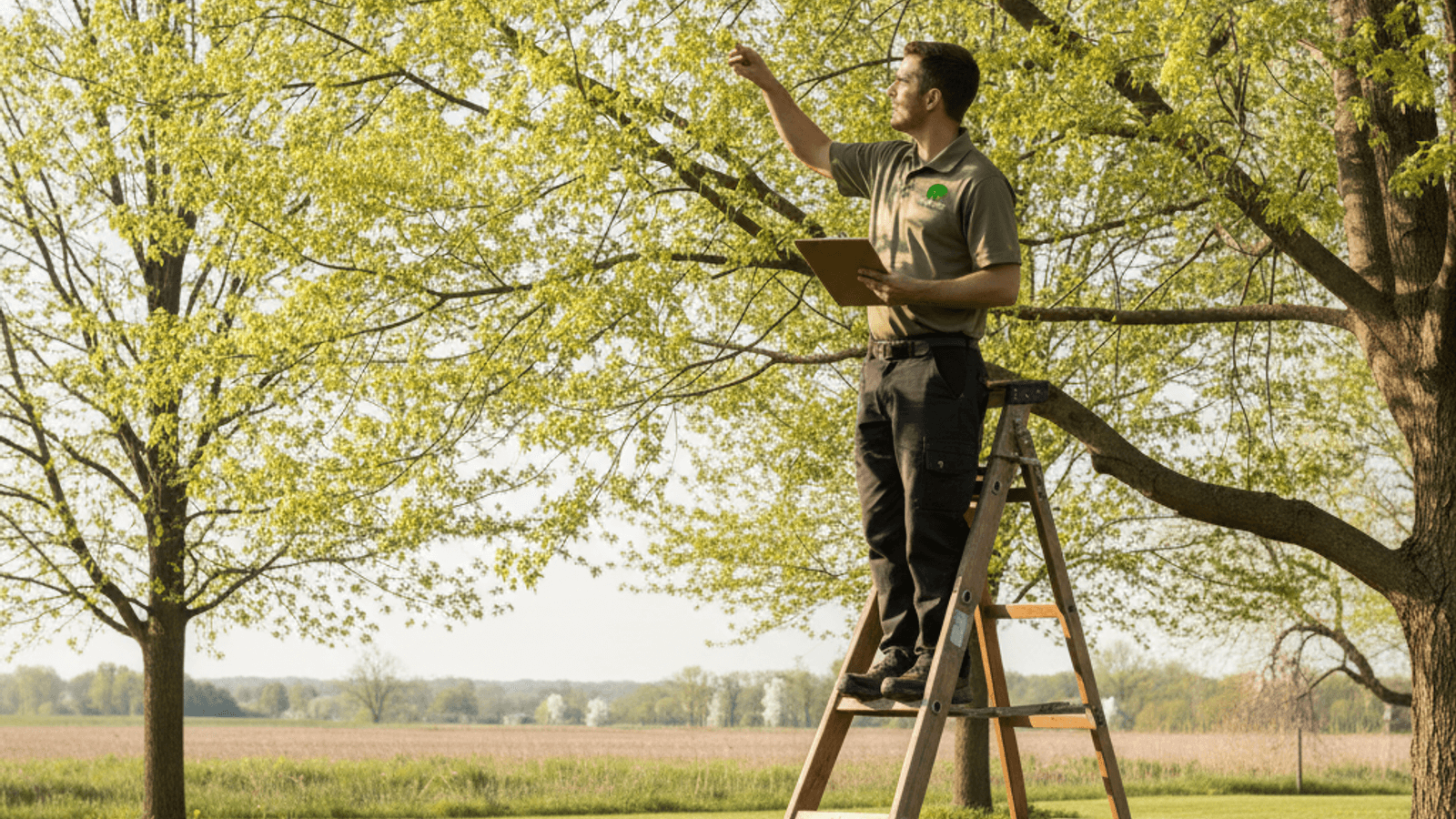
A spring tree health checklist for Topeka starts with visible damage, changing soil conditions, and safe observation from the ground. Look for broken limbs, cracks, unusual leaning, and uneven canopy growth. These signs deserve attention, but they don’t confirm a diagnosis by themselves.
Start with a safe ground-level inspection
Walk around each tree from several directions. Look upward without standing beneath damaged branches. Notice whether limbs appear broken, displaced, or caught in the canopy.
Stay clear of hanging branches, unstable trees, and downed power lines. Electrical hazards must be handled by the utility. Don’t attempt to move nearby branches or cut wood that may be under tension.
Storm damage isn’t always safe to evaluate from below. Request a professional assessment when damage involves large limbs, the main trunk, nearby structures, or areas people regularly use.
Pruning can remove selected damaged growth, but it can’t guarantee that a tree poses no future storm risk. A provider must evaluate the actual tree, its surroundings, and the intended result.
What should you check in the canopy?
Compare growth across the whole canopy instead of focusing on one twig. Make a note when one section looks noticeably different from nearby growth.
A bare branch isn’t automatically dead. Leaf development can vary, and similar symptoms can have several causes. Avoid snapping, cutting, or climbing to test questionable branches.
Watch for these visible conditions:
- Broken or hanging branches
- Cracks near the trunk or major branch unions
- Areas with sparse or uneven growth
- Bark that appears newly separated or damaged
- Branches contacting a roof, structure, or another tree
These observations help a provider know where to begin. They don’t establish whether the cause is weather, moisture, disease, insects, or another condition.
Photos can help you document visible changes. They can’t confirm a diagnosis or show whether hidden wood remains sound.
If damaged growth may need removal, review available tree trimming services. The provider should explain which branches need attention and what the written scope includes.
Check the trunk and surrounding soil
Look at the trunk from every accessible side. Note visible cracks, cavities, bark changes, or a lean that concerns you. Don’t assume a crack is stable because it appears unchanged in a photograph.
Then inspect the ground around the tree. Soil, drainage, moisture, and available light all belong in a proper tree evaluation. Both excessive and insufficient water can contribute to tree problems.
Look for changes such as:
- Newly raised or sunken soil
- Persistent standing water
- Exposed or visibly damaged roots
- Changes around the trunk base
- Recent digging, grading, or soil placement
These conditions don’t identify the cause on their own. Topeka’s geography, a neighborhood’s age, and a home’s construction date don’t prove a tree’s age, root depth, or soil condition.
A tree health assessment can consider the tree together with drainage, moisture, light, obstacles, and recent site changes.
Separate inspection from pruning decisions
Finding a questionable branch doesn’t mean it should be pruned immediately. Timing depends on the plant, its condition, and whether a safety concern requires prompt action.
K-State’s pruning guidance says deciduous trees are generally pruned before bud break, from late February through April. Dead, broken, or hazardous limbs may require a different response.
Evergreens and flowering shrubs follow different schedules. Don’t apply the general deciduous-tree window to every plant in the yard.
Oaks also require special care. K-State’s Kansas tree and shrub guidance says to avoid wounding or pruning oaks during April, May, and June.
If an oak appears damaged during that period, keep people away from the affected area and request an assessment. Our companion guide explains oak wilt considerations in Topeka without asking homeowners to diagnose an infection from general symptoms.
Don’t apply wound dressing or another treatment based on a visual guess. Ask the provider to identify the concern and explain any recommended work.
Include shrubs, hedges, and windbreaks
Shrubs and hedges deserve their own inspection. Check for broken stems, displaced branches, crowding, and visible changes around their bases.
Don’t assume they need the same pruning schedule as nearby shade trees. Flowering shrubs and evergreens can require different timing and methods. Ask how pruning could affect the plant’s natural form and intended purpose.
For help with an established planting, review hedge and shrub care. A provider can assess the actual species, condition, access, and desired shape before recommending work.
Keep a simple record without drawing conclusions
Take photographs from the same safe location and write down what you noticed. Include the date, the part of the tree involved, and any recent changes around the property.
Records can show that something changed. They can’t prove that a crack is stable, a branch is dead, or a treatment is needed.
Contact a professional when a condition appears to worsen or could affect people, buildings, vehicles, or utility lines. The guide to tree risk assessments in Topeka explains what a professional evaluation adds.
What should you ask the provider?
Ask the provider to inspect the tree in person and explain the proposed work. Useful questions include:
- What visible conditions need closer evaluation?
- Could access, drainage, moisture, or nearby obstacles affect the work?
- What does the written estimate include?
- Does the scope include hauling or stump work?
- What qualifications and insurance should I verify?
- Are any permissions needed before work begins?
- How will the provider protect nearby structures and landscaping?
If removal is recommended, ask why it is favored over pruning or continued monitoring. If pruning is recommended, ask which branches are included and what the work can realistically accomplish.
Frequently asked questions
Is a bare branch definitely dead?
No. A bare branch alone doesn’t confirm death or identify the cause. Compare it with surrounding growth, document what you see, and request an assessment before cutting a large or elevated branch.
When should deciduous trees be pruned?
K-State says deciduous trees are generally pruned before bud break, from late February through April. Dead, broken, or hazardous limbs may need different handling. Evergreens and flowering shrubs have separate timing needs.
Can an oak be pruned during spring?
K-State advises avoiding oak wounding and pruning during April, May, and June. If storm damage creates an immediate concern, stay clear and have a professional evaluate the tree.
Can photographs confirm what is wrong with a tree?
No. Photographs can document visible symptoms, but they can’t confirm the cause or reveal every structural condition. Diagnosis should consider the tree, site conditions, and surrounding hazards together.
What should I do after finding storm damage?
Stay away from hanging branches, downed power lines, and unstable trees. Don’t cut branches under tension. K-State’s storm-damaged tree guidance recommends professional assessment for dangerous damage and advises against topping.
Topeka Tree Pro connects Greater Topeka homeowners with independent licensed and insured tree-service providers. Call (785) 333-4052 to request an estimate, then confirm estimate or visit fees, availability, qualifications, insurance, and the written scope.