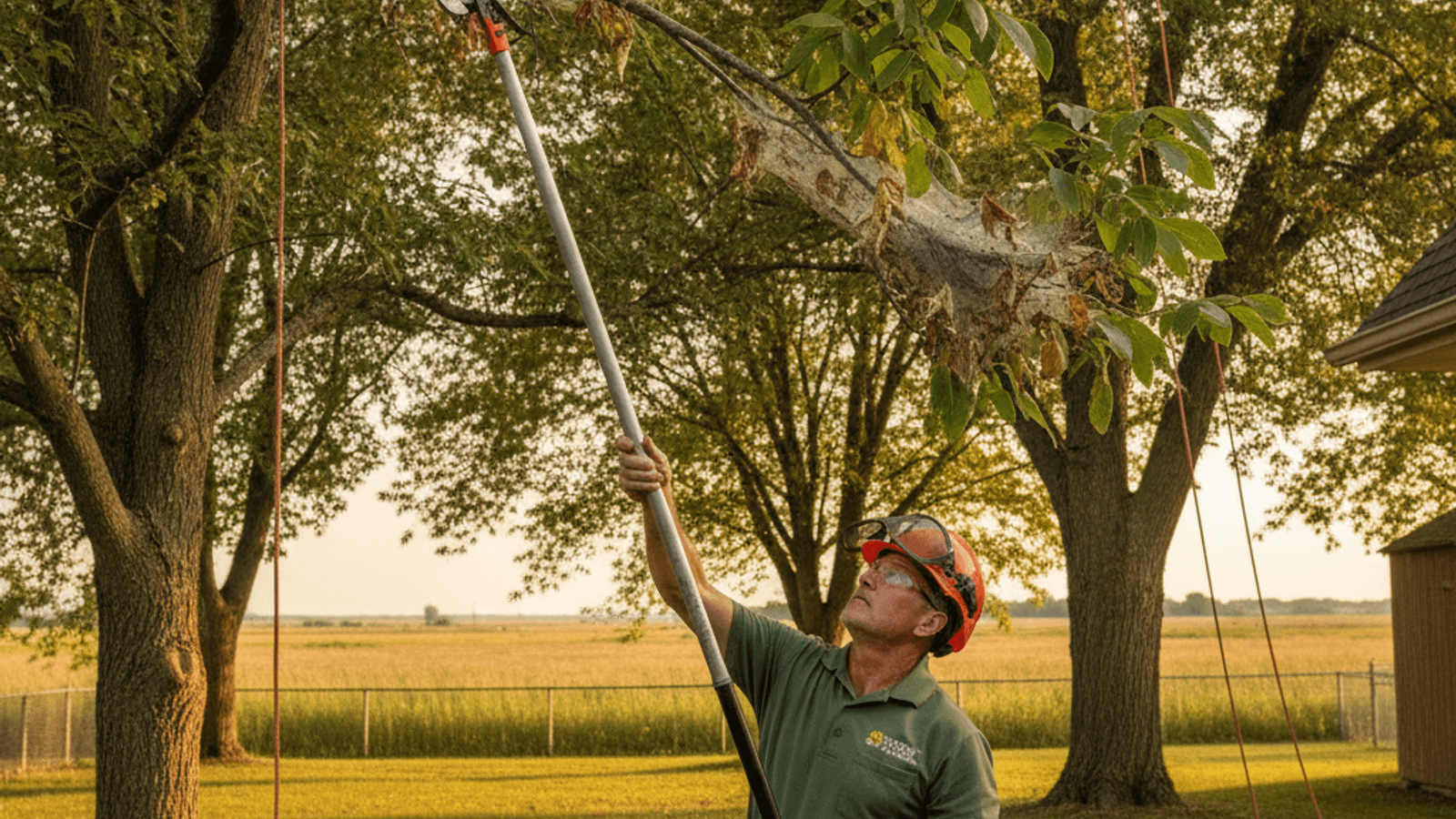
Loose, grayish-white webs around branch ends may be fall webworm, but webbing alone doesn’t confirm the pest. Check the web’s position, the host tree, the insects inside, and other symptoms. Once fall webworm is confirmed, K-State guidance says heavy feeding can defoliate a host without killing it. Pruning small accessible nests or leaving them alone on ornamental trees may both be considered.
What’s wrapped around the ends of my branches right now?
Fall webworm caterpillars build a silk web around the ends of branches, enclosing the leaves inside it. That web collects the caterpillars’ own droppings, which is part of why the nests look so ragged. K-State Research and Extension describes how it grows. Larvae start with a small web near a branch tip. They expand it as they need more foliage. Kansas has two races of fall webworm, blackheaded and redheaded, and each one runs two generations a year, for four generations total. Early in the season the two races stay staggered and distinct. By late summer, K-State says moth activity overlaps enough that one generation becomes hard to tell from another. That overlap is why a fresh nest in early August doesn’t sort neatly into a single generation anymore. K-State’s general guidance places the more visible generation in the field from late July through late September. That window covers a nest that showed up the first week of August.
Is fall webworm going to kill my tree?
No. K-State Research and Extension states plainly that high fall webworm populations can defoliate a host plant completely. They do not kill it. K-State’s entomology team adds a qualifier: the damage usually isn’t directly harmful to the tree, especially a larger one. A smaller infested tree may just look worse by comparison.
Pecan is the one real exception. K-State notes that uncontrolled webworm can cut into pecan nut production and quality, since pecan is grown for its crop rather than its shade. Control matters more there than on an ornamental tree. On ornamental trees generally, K-State’s own guidance calls control optional.
Not sure if what you’re seeing is normal wear on an established tree, or real strain on something young? A tree health assessment gets you a straight answer instead of a guess from the ground.
Fall webworm vs bagworm vs eastern tent caterpillar vs mimosa webworm: how do I tell them apart?
Four different pests build four different kinds of webbing on Kansas trees. Mixing them up leads to the wrong fix. Here’s how they line up.
| Pest | Where the web sits | Trees it hits | When it shows up in Kansas | What to do |
|---|---|---|---|---|
| Fall webworm | Encloses the ends of branches and the leaves inside | Almost all fruit, shade, and ornamental trees except conifers: birch, cherry, crabapple, elm, maples, hickory, pecan, mulberry, walnut, willow | Two generations per race, four total across Kansas’s two races; the more visible generation runs late July through late September | Prune out webs while they’re still small; spraying is a last resort and has to penetrate the webbing to reach larvae |
| Bagworm | Individual spindle-shaped bags, 1 to 2 inches, hanging off branches | Conifers hit worst: arborvitae, cedar, fir, juniper, pine, spruce | Single generation; eggs hatch mid-May to early June, feeding runs about three months | Hand-pick bags; sprays only work on small larvae in late May and June, not by August |
| Eastern tent caterpillar | Small silken tent built into the crotch of a branch | Wild cherry is the favorite; also ornamental shrubs, shade, and forest trees | Single generation; larvae hatch as trees leaf out in early spring and finish feeding by about mid-May | Usually best ignored by the time the tent is noticeable; pull an objectionable web mass off by hand or twirl it onto a pole |
| Mimosa webworm | Webs leaves together at the ends of branches | Honey locust and mimosa | Two generations per year in Kansas | Selective pruning removes isolated early infestations; once a tree is heavily webbed, K-State says it’s too late to spray |
Web location and host species are useful clues, but neither confirms a pest by itself. Webbing around a branch tip can suggest fall webworm or mimosa webworm. A tent in a branch fork can suggest eastern tent caterpillar, while individual hanging bags can suggest bagworm.
Inspect the insects and feeding pattern before choosing a response. The guides to bagworms in Topeka and Japanese beetles in Topeka explain additional identifying details. If the signs don’t match cleanly, request a professional assessment instead of treating from appearance alone.
What do fall webworm caterpillars actually look like up close?
Mature fall webworm caterpillars are yellowish with black and brown markings, with tufts of long hair. K-State’s entomology team describes a wider color range: pale green to yellow to nearly whitish, with two black spots on each abdominal segment. Kansas’s two races are told apart by head and tubercle color, not by body color. Blackheaded larvae carry black head capsules and bumps. Redheaded larvae run reddish to orange in the same spots. Both races are hairy, with long body hairs covering the caterpillar.
One feeding habit separates fall webworm from eastern tent caterpillar. Fall webworm larvae stay inside the web to feed, expanding it as they need more foliage. Eastern tent caterpillars leave the nest to forage and return to it at night or in bad weather. That difference is about feeding, not about whether a caterpillar ever leaves the nest at all. Late in the season, mature fall webworm larvae do leave the web. They crawl down toward the soil or plant debris to pupate. A wandering caterpillar on the trunk or ground in late summer can still be a fall webworm, just one that has finished feeding.
Why is this only showing up now, in August?
Fall webworm runs two generations a year within each race, and the first is small enough that most homeowners never notice it. Adult moths emerge from overwintering pupae in spring. They mate, and females lay egg masses of 400 to 500 eggs on the undersides of leaves. That first generation feeds for four to six weeks and usually goes unnoticed. The second generation is much larger and far more visible. K-State places it in the field from late July through late September, exactly the window this is. By now, K-State says the two Kansas races have overlapped enough that telling one generation from another gets hard.
K-State notes that isolated trees may show fall webworm more often than grouped trees. That observation is useful context, but lot size or geography doesn’t identify what is on an individual tree.
Inspect more than the first affected branch and compare the insects, web position, host, and feeding pattern. A spring tree health checklist can help organize a broader inspection without treating one sign as a diagnosis.
What should I actually do about the webs on my trees?
Prune out the webbed branch tips while the nests are still small, then dispose of what you cut. K-State lists this as a common control practice. Its entomology team calls pruning the most effective way to deal with an infestation, since the caterpillars stay enclosed inside the web you’re removing.
For a web that’s out of easy reach, a pole with a nail through the end works. Insert it into the web and twist the pole. The silk wraps around it, so you can pull the whole nest free and destroy it.
Don’t climb to reach webs high in a mature tree. An independent insured tree trimming provider can assess access, tree condition, and an appropriate work scope.
Chemicals are a last resort. Timing matters if you go that route: sprays need to go on while webs are still small, before much foliage is gone. Spraying the outside of a web mass won’t kill the larvae inside it. A high-pressure sprayer has to punch through the webbing itself to reach them. Spinosad, cyfluthrin, and permethrin are the active ingredients K-State lists for control. As K-State puts it, the end user must read individual product labels to ensure safe and proper use against the intended pest.
Once the webbed branches are down, sorting out where the debris goes is worth handling the same day. Otherwise you’re left with a pile of cut branches sitting in the yard.
If webworm turns out to be one of a few things going on in the canopy this season, an arborist consultation is worth it. It covers the whole tree, not just the one visible problem.
Frequently asked questions
Do fall webworms come back on the same tree every year?
They can, especially on a tree standing alone rather than grouped with others. Mature larvae from the second generation crawl down and leave the web to pupate. They shelter in the soil or under plant debris through winter. Adult moths emerge from those overwintering pupae the following spring. That puts next year’s first generation right back where this year’s caterpillars started.
Will cutting the webbed branches hurt my tree?
It depends on the branch structure, tree condition, and amount removed. Pruning a small accessible nest may be appropriate after the pest is confirmed, but unnecessary or poorly placed cuts can create other problems. Ask a provider to assess the actual tree when the nest is high, extensive, or attached to an important limb.
Which trees can host fall webworm?
K-State’s Kansas guidance names birch, cherry, crabapple, elm, hickory, maple, mulberry, pecan, walnut, and willow among the hosts. Other fruit, shade, and ornamental trees may also be affected. A host list can narrow the possibilities, but it doesn’t confirm the pest on a particular tree.
Should I spray my whole tree just to be safe?
No. K-State’s own guidance treats control as optional on ornamental trees. Pecan is the exception, since uncontrolled webworm can cut into nut production and quality there. K-State also notes it isn’t necessary to spray a whole tree over just one or two nests. Pruning out the visible webs handles the ornamental case directly. That skips the high-pressure sprayer needed to punch insecticide through the webbing on a large colony.
Can fall webworm spread from one tree to another in my yard?
Not by caterpillars crawling from tree to tree. Larvae stay inside their web to feed, expanding it to enclose new foliage. The moths are the mobile stage. Female moths lay egg masses of 400 to 500 eggs on the undersides of leaves. Different females can pick different trees in the same yard. That’s how several nests end up on separate trees at once, not caterpillars migrating between them. Checking the whole yard, not just the first tree you noticed, is worth doing if more than one host tree is present.
Get a second opinion on what’s happening in your trees
A webbed branch tip can have several explanations. Confirm the pest before pruning or choosing any treatment. Topeka Tree Pro connects Greater Topeka homeowners, including homeowners in Topeka, with independent insured tree-service providers.
If the web is out of reach or the signs don’t match clearly, call (785) 333-4052. Ask the matched provider to inspect the insects, host tree, branch condition, access, and intended result before recommending work.