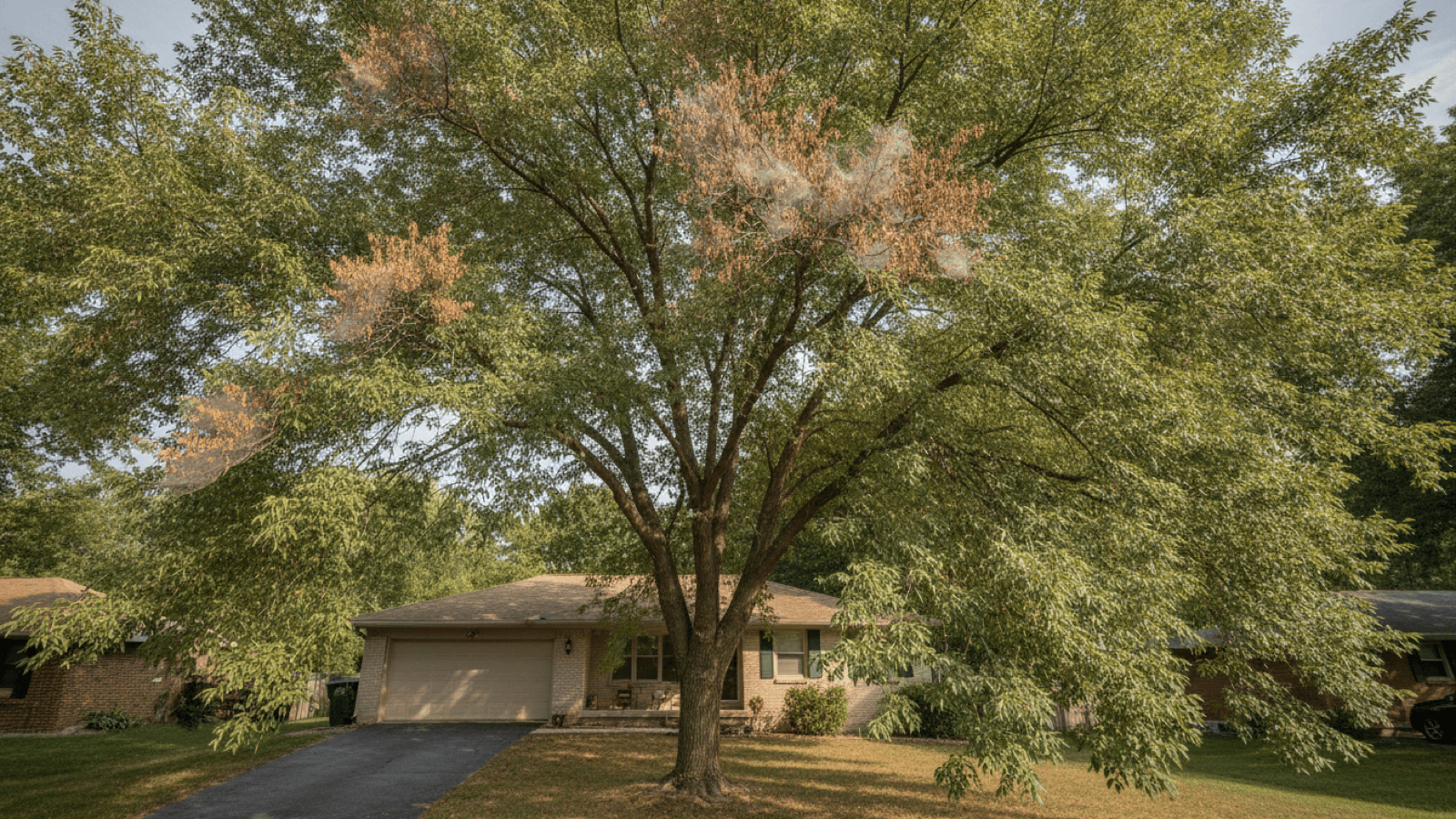
Honey locust tree problems can affect leaves, branch nodes, pruning wounds, or structural wood. K-State’s Kansas publication discusses leaf spot, honeylocust knot, canker, wood decay, bagworm, and mimosa webworm. Those entries help organize visible signs, but a symptom or short table cannot diagnose an individual tree.
What honey locust tree problems does K-State describe?
Start with the symptom, not with a pest list somebody wrote in another state. On a honey locust the trouble shows up in one of four places: the leaves, the branch nodes, an old pruning wound, or the wood inside the trunk. Here’s how those sort out.
| What you see | What K-State lists | What it means |
|---|---|---|
| Dark-red, sunken areas | Canker | Young trees may decline quickly, while mature trees can weaken slowly |
| Swollen branch nodes | Honeylocust knot | Often unattractive without reducing tree vigor |
| Cosmetic leaf spotting | Leaf spot | Rarely damaging, with no management needed |
| Mushrooms, soft wood, or hidden damage | Wood decay | Structural damage may exist before symptoms become obvious |
| Webbed, scorched foliage near the top | Mimosa webworm | Visible damage means insecticide timing has already passed |
| Bags attached to foliage or twigs | Bagworm | Use the Kansas-specific bagworm identification guide |
A species name and neighborhood don’t establish the condition of an individual tree. Soil, drainage, moisture, light, planting history, wounds, and current structure all belong in the assessment. The Southwest Topeka and Tecumseh service pages explain how to request local help.
Which honey locust tree problems does K-State actually list for Kansas?
The November 2023 K-State publication MF3132 lists four diseases and two insects in its honey locust table. That is a useful Kansas reference, not proof that no other problem can occur.
Guidance from another state may describe organisms or conditions that are not established by the Kansas table. Use it as background rather than a diagnosis. A provider should assess the actual tree, site conditions, and pattern of symptoms before recommending work.
Leaf spot is the easiest one to let go of. K-State calls it “Rarely damaging, primarily cosmetic, no management needed.” Spotted leaves on their own aren’t a reason to take a stable tree down. Branch dieback, soft wood and a crown that’s thinning out are the symptoms worth chasing.
Is the webbing at the top of my honey locust mimosa webworm?
It may be mimosa webworm, but webbing alone doesn’t confirm the cause. The host tree, insects present, feeding pattern, timing, and other symptoms should be checked together. K-State explains that mimosa webworm caterpillars create protective webs near treetops, which can make established infestations difficult to reach.
Kansas runs two generations a year. The second one is the late-summer batch, and it’s the one people call about, because that’s when the tree starts to look burnt. K-State says heavily infested trees are “brown or scorched in appearance” “because the caterpillars skeletonize the leaf tissue”. The leaves are still there. The green has been eaten off them.
The caterpillars themselves are about half an inch long full grown, “green to dark brown, with white stripes extending the length of the body.” Poke one and it backs up fast. Later in the season they leave on a silk thread and pupate in bark crevices, or stuck to the side of your house.
If the webbing is on something other than a honey locust or a mimosa, it’s probably a different insect. Our fall webworm guide sorts the two apart by host tree.
Why spraying in late summer does not work
Because you’re already too late. K-State’s Kansas table puts it in one sentence: “Once damage is noticeable, it is too late to apply an insecticide.”
The reason is the webbing itself. As the K-State mimosa webworm guidance explains, “It is too late to apply an insecticide this time of year when trees are heavily infested with webbing because the caterpillars are protected from insecticide spray applications inside the leaf webbing.” Spray hits the outside of a web. The caterpillars are on the inside of it, thirty feet up.
Visible late-season webbing doesn’t justify choosing a product or making cuts without confirming the cause. K-State notes that selective pruning may remove an isolated or localized mimosa webworm infestation when pruning is feasible.
A qualified provider should assess access, branch condition, infestation extent, and the intended result before cutting. Topeka Tree Pro can connect you with an independent insured tree-trimming provider, but treatment availability and recommendations must be confirmed directly with that provider.
What canker does to a honey locust, and where it starts
Canker often starts where an old pruning cut opened live tissue. K-State’s wording is specific: “Sunken, dark-red cankers form in branch crotches or at pruning wounds”. The symptoms it lists are “Branch dieback, reduced foliage and premature defoliation.”
Water stress feeds it from either direction. K-State calls honeylocust canker “Common in trees stressed by drought or over-watering.” Soaking a struggling tree isn’t the safe option people assume it is.
K-State states that young trees may decline rapidly while mature trees may remain weakened for many years. That language doesn’t establish a countdown for an individual tree. Current symptoms, site conditions, branch changes, wounds, and overall structure need to be assessed directly.
Now the part that’s easy to misread. MF3132 puts the cankers “at pruning wounds” and then, in the very next column, tells you to “Maintain tree health with proper pruning, fertilization, and watering.” Both sentences are the publication’s own. They aren’t in conflict. Pruning isn’t the problem. Careless pruning is, because every cut is an opening, and this species keeps a record of the bad ones.
So the guidance isn’t to leave the tree alone. It’s to cut deliberately and in the right place: “Prune out all cankered branches to 1 foot below visible damage.” A foot below what you can see, not flush with it. There’s a second instruction on the same line: “Avoid mechanical wounds to the trunk.” In a yard, that’s the mower and the string trimmer.
That’s four different problems that all start with a tree looking off, and telling them apart from the ground is genuinely hard. A tree health assessment is how you separate canker from webworm damage, cosmetic spotting and decay you can’t see yet.
Are the knots on my branches a problem?
Honeylocust knots are usually more alarming than damaging. K-State describes “Small, swollen galls at branch nodes. Shoot blighting may also occur.”
Their cause remains unsettled. MF3132 says they are “Suspected to be caused by a bacterium and/or herbicide damage, but causation not fully understood.” Appearance alone can’t settle which suspected factor contributed.
K-State adds, “In many cases this condition does not affect tree vigor, just causes unattractive knots.” Monitoring may be reasonable after a qualified assessment finds no current action is needed. A lack of obvious change from the ground does not prove that the tree is stable.
K-State does say “Some cultivars are more susceptible than others.” It doesn’t name which ones, so neither will we. Nobody can read a cultivar off a photo of a knot anyway.
If affected branches need cutting, follow the current source guidance and the tree-care provider’s instructions for tool sanitation. Don’t assume every knot has an infectious cause, because K-State notes that causation is not fully understood.
When decay means the tree comes out
Wood decay becomes a removal issue when structural risk develops. K-State warns, “Symptoms of decay may not be visible until extensive structural damage to the tree has resulted.”
Look for crumbly, spongy or discolored wood, and for mushrooms or conks at the base. A full green crown doesn’t rule any of that out. The tree can look fine from the driveway and still be hollow where it counts.
There’s no fixing it once it’s started. K-State is blunt about that: “There is no control once the fungus has colonized the wood.” Its instruction from there is short. “Trees with indications of decay should be evaluated by a tree-care professional.” And then: “Trees that are a structural risk should be removed by a certified arborist.”
K-State’s decay section says loss of strength can pose a risk to structures, vehicles, or people during wind or ice. The actual risk depends on the tree’s condition, likely failure points, and nearby targets.
A tree risk assessment examines the trunk, roots, branch unions, targets, and likely failure points. The site’s guide to recognizing a dead or declining tree helps homeowners organize visible symptoms before that visit.
When decay has already compromised the structure, pruning can’t rebuild wood. A second opinion through an arborist consultation can clarify whether monitoring remains reasonable. Confirmed structural risk may require professional tree removal.
Frequently asked questions
Which honey locust tree problem is most serious?
Wood decay deserves prompt professional evaluation because it can reduce structural strength before the full extent is visible. Canker, knots, leaf symptoms, and webbing require different responses, but their seriousness cannot be ranked for an individual tree without examining its condition and surroundings.
Will honeylocust knots kill the tree?
Usually not. K-State says that in many cases the condition doesn’t affect tree vigor and just leaves unattractive knots behind. Shoot blighting can happen alongside them, so a branch that’s actively changing is still worth a look.
Should I spray visible mimosa webworm damage?
Don’t choose a spray from visible webbing alone. K-State says noticeable, heavily webbed infestations can be protected from spray applications. Confirm the insect first, then ask a qualified provider whether monitoring or selective pruning is appropriate for the actual tree.
Can a cankered honey locust be pruned?
A cankered branch may be pruned when a qualified assessment supports that response. K-State’s publication provides specific pruning and sanitation guidance, but the provider should first confirm the condition, affected tissue, safe access, and appropriate cut location.
Does K-State list honeylocust borer as a Kansas problem?
MF3132’s honey locust table lists bagworm and mimosa webworm, not honeylocust borer. That means the borer is not listed in that table; it does not prove the insect could never occur. Use Kansas guidance and an examination of the actual tree before identifying the cause.
When should I think about removing and replacing it?
When someone qualified has looked at it and found structural risk from decay. That’s the threshold, not a bad-looking season. If it gets there, our tree removal cost guide covers what the work runs and our replacement planting guide covers what comes next. Neither one is a substitute for someone standing under the tree.
Get it identified before the next cut
Leaf spots, webbing, cankers, knots, and signs of decay call for different decisions. None should be diagnosed from one symptom or a neighborhood description. Keep people away from hanging branches or unstable damaged trees, and request professional assessment when structure or safe access is uncertain.
Topeka Tree Pro connects homeowners across Shawnee, Jefferson, Jackson, Osage, and Wabaunsee counties, including Topeka, with independent insured providers. Call (785) 333-4052 to request an estimate, then verify availability, qualifications, insurance, and the written scope directly with the matched provider.