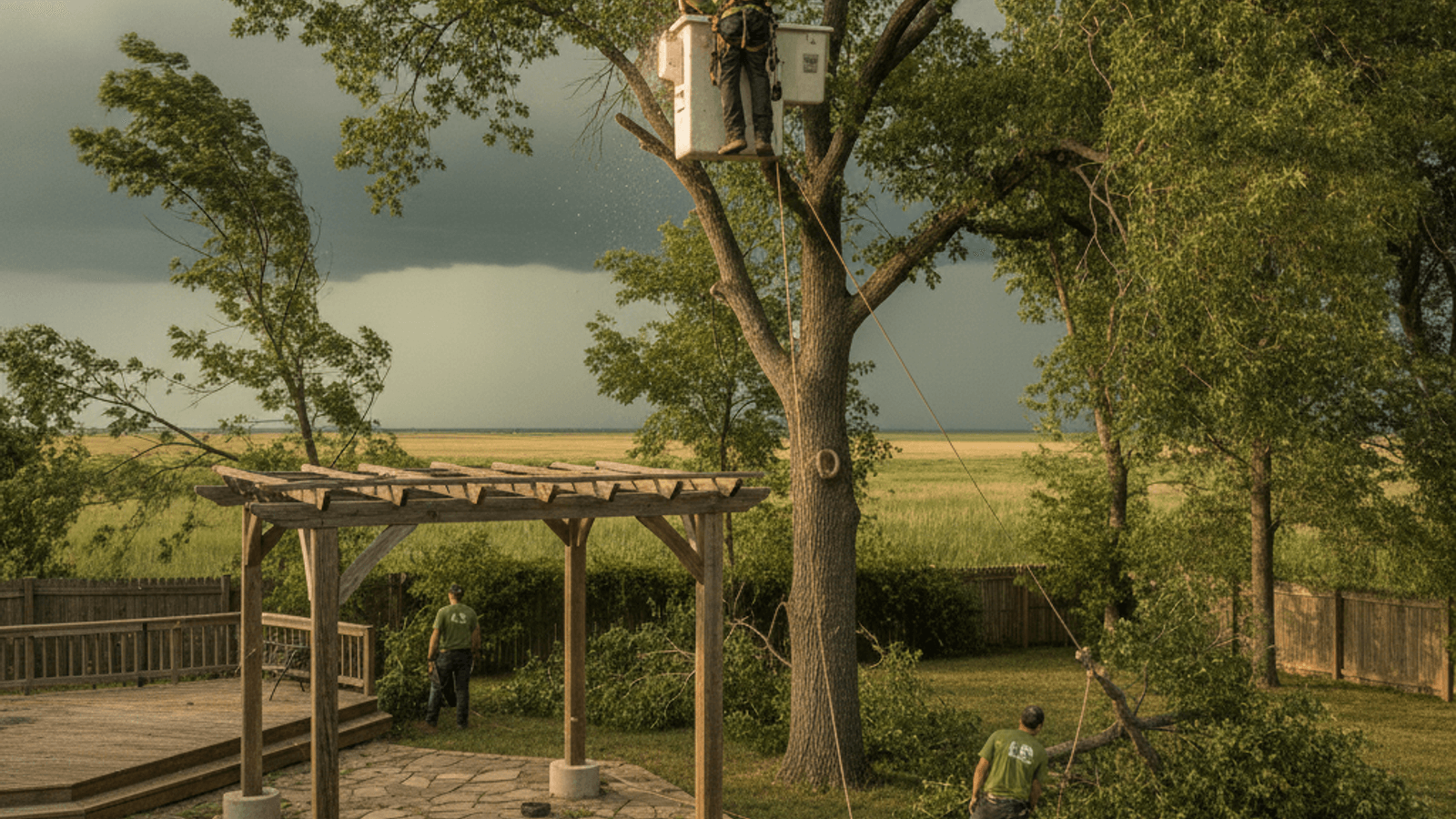
Tornado season tree prep in Topeka starts with identifying damage and nearby targets. No pruning or support system can storm-proof a tree. An in-person assessment can help determine whether monitoring, pruning, support, or removal fits the actual condition.
Why some trees fail and others don’t
Tree failure can’t be predicted from canopy density alone. Branch unions, existing damage, roots, soil moisture, drainage, nearby construction, and exposed targets all belong in the assessment.
A provider should examine the individual tree and surrounding site. A tree that looks unchanged from the ground isn’t proven stable, especially after damage or soil movement.
When is crown thinning appropriate before storm season?
Crown thinning may be one part of tree trimming, but it isn’t appropriate for every tree. Excessive or poorly placed cuts can create new problems. Topping should also be avoided.
Ask the provider which branches would be removed and why. The written scope should connect each cut to a specific structural, clearance, or deadwood concern rather than promise storm resistance.
Structural cabling on split-prone unions
A codominant union can warrant closer examination, especially when cracking or movement is visible. Species alone doesn’t establish that a particular union will fail.
Cabling and bracing may be considered after an assessment of the tree and defect. Ask what the proposed system addresses, what monitoring it requires, and which alternatives were considered. Compare written scope rather than assuming support is always cheaper or appropriate.
Removing already-weak trees before they become the storm’s problem
Some damage may make pruning or structural support unsuitable. Trunk decay, canopy dieback, cracking, or root-plate movement needs an in-person review. Those signs don’t establish the correct response by themselves.
Property age or neighborhood doesn’t diagnose an individual tree. Owners in Oakland and Highland Park can request a tree health assessment based on the tree’s actual condition and surroundings.
Checking drainage and root plate stability
Site conditions also matter. K-State guidance includes soil, drainage, moisture, and light when evaluating tree problems. Both excessive and insufficient water can contribute to trouble.
Report standing water, a newly noticed lean, or soil movement during an assessment. Those observations deserve attention, but none proves a specific root condition from the ground.
Prioritizing which trees to address first
Most yards have more than one tree that could use attention, and it helps to think in terms of what’s actually at risk if a given tree fails. A large tree standing over a house, a detached garage, or a spot where a car regularly parks carries far more consequence than the same size tree in an open corner of the yard with nothing underneath it. Start with proximity to structures and high-use areas, then work outward.
Species and growth history can inform an assessment, but they don’t set priority alone. Begin with visible defects, recent changes, and what could be struck. Compare each tree’s actual condition rather than relying on age or species stereotypes.
The same ranking drives a bigger property, just with more trees and a purchase order attached. If you’re prepping an HOA common area, a church lot, or a commercial site rather than a yard, our guide to scoping a commercial tree service bid in Topeka covers how to put that priority order into written specifications a crew can quote against.
What a storm-prep visit actually looks like
Ask the provider to examine visible branch unions, trunk damage, soil movement, roots, canopy condition, access, and nearby targets. The findings should support any recommendation for monitoring, pruning, support, or removal.
Request a written estimate that identifies the tree, proposed work, hauling, and any follow-up. Costs depend on the actual condition, access, obstacles, and selected scope. Preventive work isn’t a guarantee against storm damage.
What homeowners can check between professional visits
From a safe distance, look for new canopy gaps, hanging branches, fresh cracks, or lifted soil. Don’t approach unstable trees, hanging limbs, or downed power lines. Contact the utility for electrical hazards and request professional assessment of dangerous damage.
Fresh damage may need prompt attention. An unchanged appearance doesn’t prove the tree is stable.
Tell the provider about nearby trenching, grading, paving, or construction. Root disturbance may not produce immediate canopy symptoms, so the timing and location of that work can help guide the assessment.
Building a realistic timeline for the work
Don’t assign a safe waiting period from a generic symptom list. Keep clear of hanging branches and unstable damaged trees. A visible split, recent movement, or deadwood over an occupied area warrants professional assessment.
Ask the provider to prioritize each tree by condition, nearby targets, and access. Confirm scheduling directly rather than relying on a standard arrival window.
Frequently asked questions
When should I have my trees checked before storm season?
Schedule an assessment before urgent weather arrives when practical. Pruning timing varies by species and condition. K-State generally places deciduous pruning before bud break, while warning against oak wounding or pruning during April, May, and June. Dead, broken, or hazardous limbs require separate safety judgment.
Can crown thinning hurt a healthy tree?
Yes, unsuitable or excessive pruning can damage a tree. Have the provider explain why thinning fits the specific tree, which branches are included, and how the proposed cuts support the intended result.
Is cabling a permanent fix, or does it need to be checked again?
Cables and hardware should be inspected periodically, especially after major storms, since the tree keeps growing and the load on the union can shift over time. Think of it as ongoing structural support rather than a one-time install you never think about again.
Topeka Tree Pro connects Greater Topeka homeowners with independent insured tree-service providers. Call (785) 333-4052 to request an estimate. Confirm availability, qualifications, insurance, and the proposed scope directly with the matched provider.