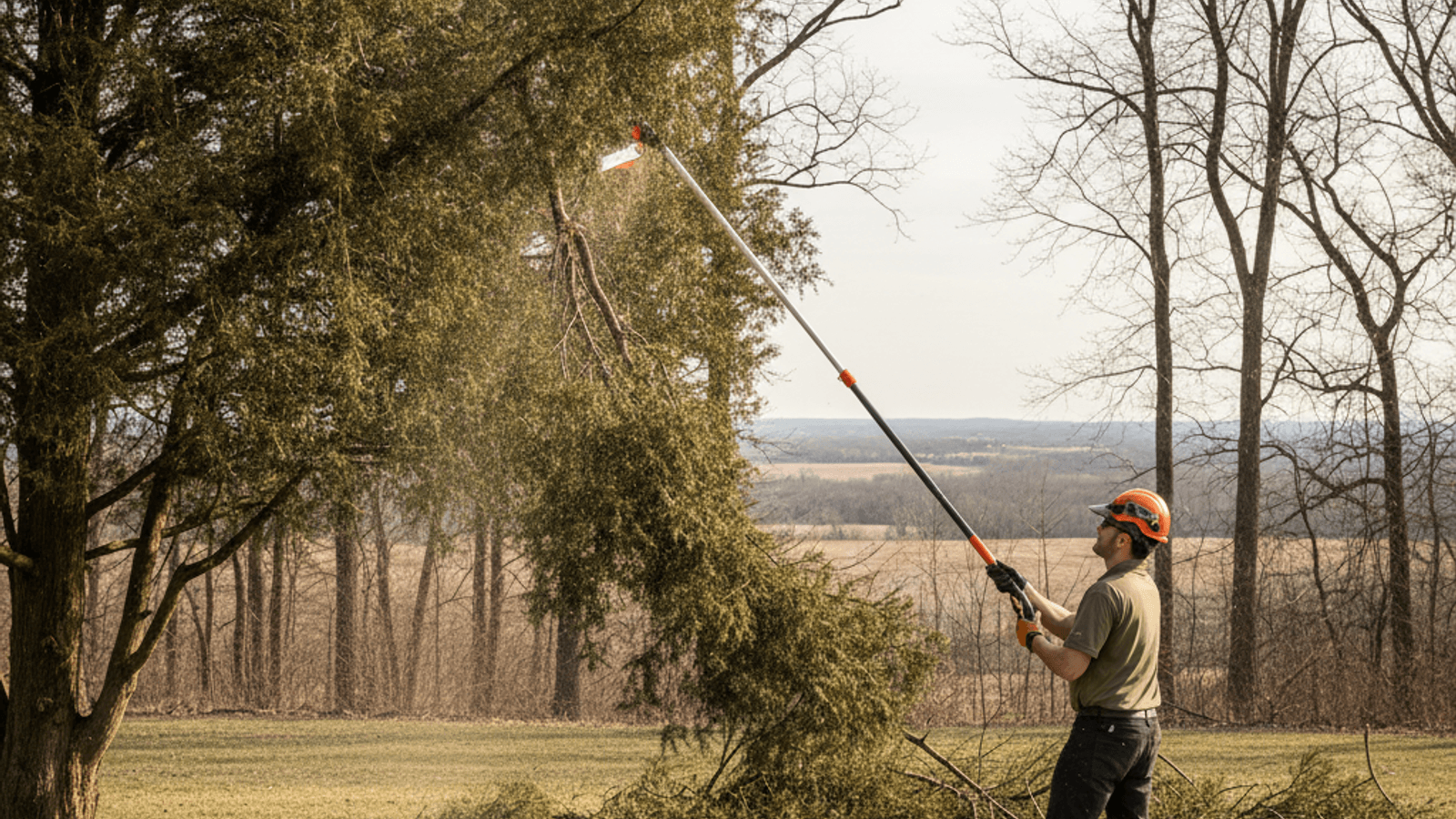
Cedar tree trimming in Topeka should follow the tree’s species, condition, site, and pruning goal. Evergreens don’t share one universal pruning calendar. Dead, broken, or hazardous limbs may need separate attention. A provider should inspect access, nearby obstacles, and the intended result before recommending work.
Why cedar trees matter in Topeka’s landscape
Eastern redcedar (Juniperus virginiana) and other evergreens need species-specific pruning decisions. Soil, drainage, moisture, light, nearby construction, and visible damage all belong in the assessment. The county or neighborhood doesn’t reveal an individual tree’s condition.
A cedar that looks unchanged from the ground isn’t automatically stable. Dead branches, weak unions, root-zone changes, and canopy condition need evaluation in context. The goal is a defined result, not trimming on a fixed recurring schedule.
Small bags or damaged foliage don’t establish a diagnosis by themselves. A provider should examine the tree and surrounding conditions before recommending treatment. Our guide to bagworms in Topeka explains what information to gather before choosing a response.
The best time to trim cedar in the Topeka area
K-State’s pruning guidance explains that timing differs among evergreens, deciduous trees, and flowering shrubs. The general calendar for deciduous trees shouldn’t be applied automatically to cedar. Dead, broken, or hazardous limbs also require separate timing and safety decisions.
Ask the provider to identify the tree, explain the pruning objective, and account for its condition and site. If a limb is hanging, near a power line, or under tension, keep clear and seek professional or utility help.
What to trim and how much
The appropriate pruning amount depends on the cedar’s condition and the intended result. Ask the provider to identify each proposed cut and explain its purpose. Common assessment points include:
Remove dead wood first. Dead branches inside the canopy don’t do anything but collect moisture and provide entry points for disease. They’re also weaker and more likely to break if wind gets into them.
Thin out crossing or rubbing branches where two limbs are growing against each other or where one is growing back into the canopy instead of outward. These weaker points are exactly where problems start.
Reduce weight on branches that show a narrow angle to the trunk. Cedar can develop long, heavy limbs on weak unions if left untended, and Topeka’s ice storms and tornado-season wind will test that weak point hard. Shortening or removing a heavy limb on a poor union prevents a much bigger problem later.
Define any canopy-density objective before work begins. Ask why live branches need removal and what the finished canopy should accomplish. A visual rule about seeing through the crown isn’t a substitute for assessing the individual tree.
Don’t choose a pruning dose from a fixed percentage alone. Species, health, structure, site conditions, and the pruning objective affect how much live growth should be removed. Ask the provider to document the proposed scope before cutting begins.
Cedar trees and storm season in Topeka
Storm preparation starts with the tree and site that actually exist. A provider should assess dead or broken branches, unions, access, nearby structures, and the intended result. A tree health assessment can help separate structural concerns from symptoms that may have several causes.
After damage, stay clear of downed power lines, hanging branches, and unstable trees. Don’t cut branches under tension. Electrical hazards belong with the utility, while dangerous tree damage needs professional assessment. Emergency tree service can connect you with an independent provider for an on-site evaluation.
The cedar fever factor
Pollen concerns don’t establish when a particular cedar should be pruned. Pruning decisions should follow the species, tree condition, site, and intended result rather than an assumed allergy calendar.
If pollen affects your health, discuss exposure with a qualified health professional. Ask the tree-service provider how the proposed scope affects the canopy, but don’t treat trimming as a medical recommendation or guaranteed allergy solution.
When removal becomes the right answer
Removal may be considered when the tree conflicts with the space, has serious damage, or no longer fits the owner’s intended use. Those conditions don’t decide the outcome by themselves. Ask a qualified provider to assess the tree, nearby targets, access, and reasonable alternatives before non-emergency work.
An eastern redcedar stump doesn’t normally resprout. The USDA’s Silvics of North America states that eastern redcedar “does not reproduce naturally by sprouting or suckering.” Stump grinding reduces the visible stump for surface use, but it doesn’t remove the entire root system. Ask what grinding depth and site restoration the quote includes.
Cedar across a pasture or fence line requires a different site assessment. Ask providers to inspect density, access, obstacles, debris handling, and the intended end result. Our guide to land clearing cost around Topeka explains how to compare that scope.
Pricing and hiring for cedar work
Cedar trimming and removal don’t have a verified standard price for every property. A provider needs to inspect the tree, access, obstacles, condition, and intended result. Ask for a written quote that separates pruning or removal, hauling, stump work, and optional restoration.
Topeka Tree Pro connects Greater Topeka homeowners with independent insured tree-service providers. Verify insurance, qualifications, availability, written scope, and required permissions directly with the provider. If disease is suspected, ask a qualified professional how cut material should be handled.
How often does a cedar tree need trimming?
Trimming intervals vary among cedar trees. The next inspection or pruning decision should reflect the tree’s species, condition, site, recent changes, and previous work. Ask the provider which conditions would justify another visit.
Is cedar wood good for anything after it’s trimmed?
Yes. Cedar trimmed wood is fragrant, rot-resistant, and useful for mulch, fence posts, or smaller projects. If your crew isn’t chipping or taking the wood, ask if they can leave it. Some people use cedar chips for paths or mulch, and some sell the larger pieces. It’s worth asking before the job’s done.
Do I need a permit to trim my own cedar in Topeka?
For work on public property, Topeka Municipal Code 12.65.030 requires a Forestry permit. If the ownership or right-of-way boundary is unclear, confirm it before scheduling. Our guide to tree removal permit rules in Topeka explains what to verify. Also check property agreements and current local requirements.
Can a split or storm-damaged cedar be saved?
Possibly, but the visible split alone doesn’t decide whether the cedar can remain. Keep clear of hanging limbs, unstable trees, downed lines, and branches under tension. A qualified provider should inspect the complete tree and site before recommending pruning, monitoring, or removal.
Topeka Tree Pro connects Greater Topeka homeowners with independent insured tree-service providers. Call (785) 333-4052 to request an estimate, then verify availability, qualifications, and the written scope directly with the provider.