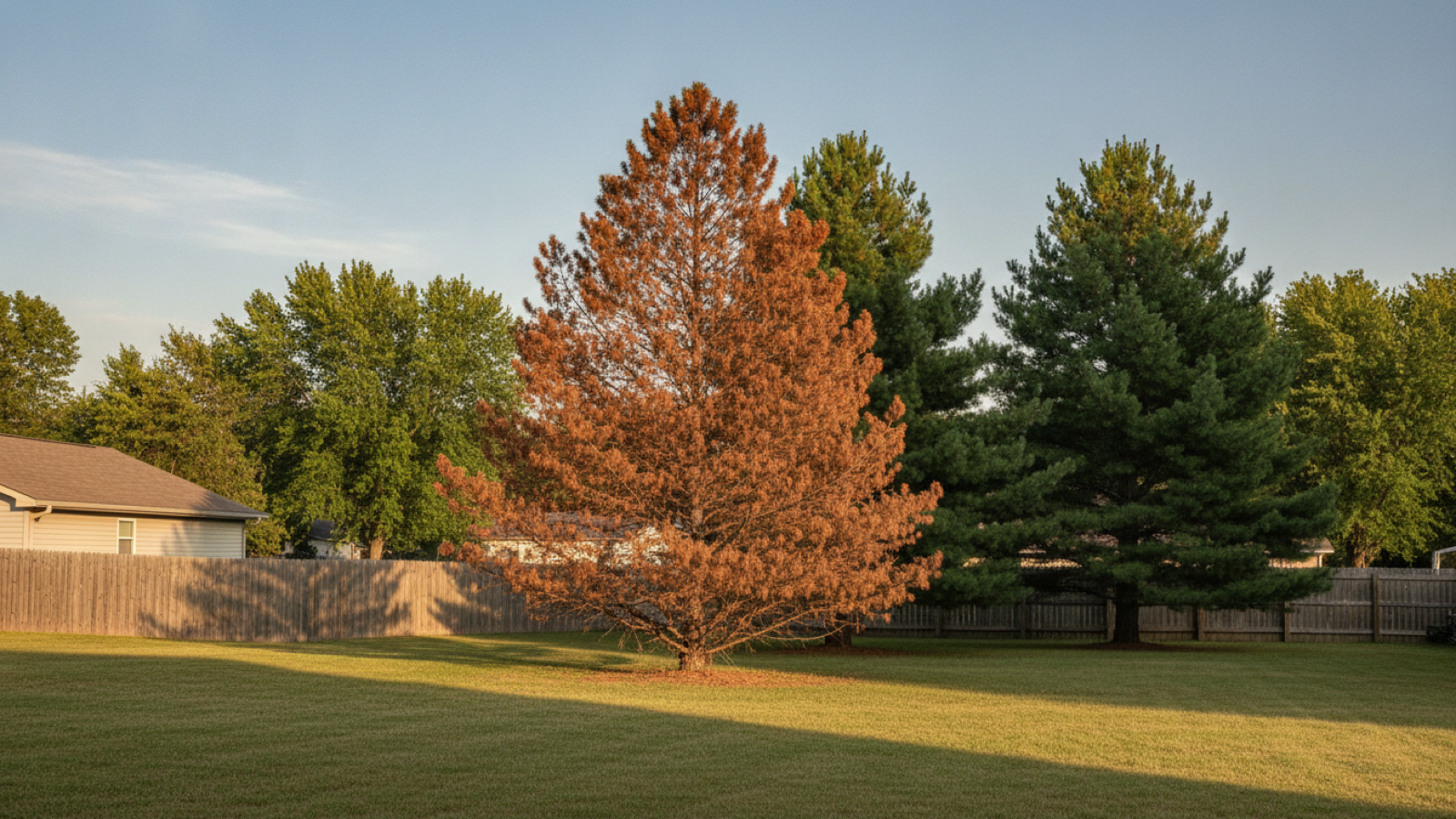
A pine tree turning brown in Topeka needs a diagnosis before treatment or removal. Pine wilt is one possibility, but drought stress, bark injury, fungal disease, and natural needle drop can produce overlapping signs. Note how quickly the color changed, keep clear of unstable branches, and arrange an assessment or laboratory test before deciding what to do.
Why is my pine tree turning brown in Topeka?
Several conditions can brown a pine, and they don’t receive the same response. Pine wilt, fungal diseases, site stress, bark injury, and normal needle turnover can overlap visually. The pattern and pace help narrow the possibilities, but they don’t confirm the cause by themselves.
The pace of browning is useful evidence. K-State Research and Extension publication L722 (Megan Kennelly, February 2013) describes pine wilt as a rapid decline, while some fungal problems progress more gradually. A fast change still doesn’t rule out drought, root problems, bark injury, or another cause, so use the timeline to guide testing rather than declare a diagnosis. The comparison below follows that 2013 table. Similar symptoms still require diagnosis.
| What it is | How fast | Where the browning starts | Clues that need confirmation |
|---|---|---|---|
| Pine wilt | Weeks to a few months, whole tree | Branch by branch, or all at once | Resin reduced or absent; branches dry and brittle; dead needles hang on up to a year |
| Tip blight | Years, section by section | Lower tree, working upward | Stunted new shoots (candles); dried resin on dead shoot tips; black specks on 2-year-old cones |
| Dothistroma needle blight | Years | Needle tips | Red banding and browning on needle tips; best confirmed December through April |
| Drought scorch | A season | Needle tips, downward | Half or full needle scorch, sometimes only on the windward side of the tree |
| Natural needle drop | Annual, normal | Oldest, innermost needles | Interior needles yellow and shed while the outer canopy stays green |
Reduced resin and dry, brittle branches can support concern about pine wilt, but neither sign confirms it. Don’t make a fresh wound solely to test the tree. Photograph existing symptoms and let a qualified provider or plant diagnostic laboratory determine whether sampling is appropriate.
What is pine wilt, and why does it kill a pine so fast?
Pine wilt is caused by the pinewood nematode, a microscopic worm, and it’s carried tree to tree by the pine sawyer beetle, a long-horned borer. The nematode feeds and multiplies inside the tree’s resin canals. As it destroys those cells, the tree’s water-moving system clogs, resin flow slows and stops, and the tree wilts and dies. K-State puts that timeline at several weeks to several months.
L722 places the decline in the warm season, when nematodes feed and multiply in the resin canals and resin flow stops. That is a different process from a fungus that colonizes tissue over several seasons. The publication does not describe a way for the tree to reverse an established infection.
For a confirmed infection, the beetle stage affects removal timing and wood handling. K-State explains that beetles can emerge from infected wood and carry nematodes to other pines. Confirm the diagnosis, then ask the Extension office and tree-service provider how current guidance applies to the tree and planned work.
Which pines in a Topeka yard are actually at risk?
Kansas has no native pine species. L722 notes that pines have been widely planted for ornamental, windbreak, and conservation uses.
Scots pine is particularly susceptible. Austrian, white, and mugo pines are also hosts. The February 2013 publication said increasing numbers of Austrian pines had been affected in the years leading up to that document, and it described pine wilt as common across the eastern two-thirds of Kansas and still spreading west. Those are 2013 document claims, not a current surveillance update.
The Kansas Forest Service windbreak management page, updated April 16, 2026, reports that as of 2021 Kansas had 31,348 miles of windbreaks covering 261,536 acres. That figure is all state windbreaks, not a pine-only count and not a 2025 inventory. It does not establish when a particular pine becomes vulnerable, and it does not diagnose a Topeka yard tree. Homeowners in Topeka still need the actual symptoms and site conditions evaluated.
A browning spruce, fir, arborvitae, cedar, or juniper needs a different diagnostic process. Don’t assume a local pest from color alone. Review the Topeka bagworm guide or the guide to a blue spruce browning from the bottom up for species-specific clues.
Is it pine wilt or something else? Getting it confirmed
You can’t confirm pine wilt by looking at the tree. The symptoms overlap with tip blight in the early branch-by-branch stage, and pines sometimes die fast from drought and bark beetle injury without any nematode involved at all. A lab test is the only way to know.
L722 routes a suspect sample through a local K-State Research and Extension office to the K-State Plant Disease Diagnostic Lab. For Shawnee County, that office is the Shawnee County Extension Office. The 2013 publication describes professional sample types the lab can use, including an adequate branch taken right against the trunk or a wedge or cross-section. Coordinate collection with a qualified provider and the Extension office so the sample matches current lab requirements. Don’t cut lower-trunk wood, climb, or take unstable limbs yourself.
Laboratory fees and provider charges can change, so request current terms directly. For a tree health assessment, ask what the written estimate includes, whether laboratory sampling is separate, and who will collect and submit any sample. The assessment can narrow the possibilities, but laboratory testing may still be needed to confirm pine wilt.
What should I do if the test comes back positive?
A confirmed positive result calls for prompt planning with the Extension office and an independent tree-service provider. L722’s February 2013 guidance is to remove an infected tree before beetle emergence, cut it to the ground, and not leave a stump. Don’t keep the wood as firewood. That publication mentions chipping or burning as handling methods, but disposal has to follow a lawful professional plan for the actual site, season, access, and surrounding pines.
Don’t cut unstable limbs, handle branches under tension, or work near electrical lines. Keep people away from hazardous areas and contact the utility for electrical hazards. Ask the provider to explain how the trunk, branches, chips, and stump will be handled in the written scope.
Don’t move or keep suspected diseased wood until a qualified source confirms the appropriate method. Review the Topeka tree-debris disposal guide and settle hauling and disposal responsibilities before work begins.
Removal cost depends on the tree’s condition, size, access, nearby obstacles, hauling needs, and whether stump work is included. Ask an independent provider for a written tree removal estimate and compare the included scope. The Topeka tree removal cost guide explains the questions to ask without treating another property’s quote as your price.
Why does the beetle cycle affect removal timing?
For confirmed pine wilt, removal timing is intended to interrupt the insect stage that can carry nematodes to another pine. The correct plan depends on when the diagnosis is confirmed and how the infected material will be handled.
Don’t interpret a tree that looks unchanged through winter as stable or harmless. Ask the Extension office and provider to confirm the current deadline and disposal method for the actual case. Keep remaining trees appropriately watered for their site conditions, since both too much and too little water can cause problems.
Can pine wilt be treated?
Not after the fact. L722 states that injections are for prevention only. They do not cure a tree after infection.
Preventive injection is a different question and a legitimate one for a high-value tree that isn’t infected yet. The February 2013 L722 product table lists abamectin and emamectin benzoate. In the trials that publication cites, injectable products significantly decreased pine wilt infections but did not provide 100 percent control. That 2013 table is not a verification of current product registration or 2026 availability. Follow the current label, and note that some products are restricted to certified applicators. They have to be applied by a trained tree care professional, and they’re a decision about the pines you still have, not a rescue for the one that’s brown. An arborist consultation is the right place to weigh that against the value of the tree and nearby host pines.
The distinction between prevention and post-diagnosis action also appears in the guides to emerald ash borer in Shawnee County and Dutch elm disease in Kansas and Topeka. Each problem still requires its own diagnosis and management plan.
Frequently asked questions
How fast does pine wilt kill a tree in Kansas?
K-State describes pine wilt as a rapid decline that can progress within weeks or months. Speed is a useful clue, but it doesn’t confirm pine wilt or exclude drought, bark injury, root problems, or another disease. Laboratory testing may be needed.
Will my brown pine drop its needles?
Dead needles may remain attached for an extended period after pine wilt, but retained needles aren’t proof of the disease. Record the pattern and timing, then use professional assessment and laboratory testing when confirmation matters.
Can I keep the wood from a pine wilt tree for firewood?
Don’t keep or move wood from a confirmed pine-wilt tree without current handling guidance. Ask the Extension office and provider to specify the approved disposal method and include hauling in the written scope. Don’t burn material unless local conditions and applicable rules allow it.
Is pine wilt dangerous to my oaks, maples, or cedars?
L722 discusses pine wilt on pine hosts, including Scots, Austrian, white, and mugo pines. That publication does not treat oak, maple, spruce, fir, arborvitae, cedar, or juniper as pine-wilt hosts. A browning tree of another species still needs its own diagnosis. For a blue spruce, start with the four signs that brown one in Topeka.
Should I replant a pine in the same spot?
Don’t choose a replacement from the failed tree’s appearance alone. Ask for species options suited to the property’s light, drainage, moisture, heat, available space, and disease concerns. A confirmed infection in one tree can inform that decision, but it doesn’t diagnose every nearby property.
Does the stump need to come out too?
L722’s 2013 instruction is to cut the tree to the ground and not leave a stump. Grinding the stump afterward is a separate service and a separate line item, and it’s worth pricing at the same time as the removal rather than as a second call later.
Getting a straight answer on a browning Topeka pine
A browning pine deserves a timely assessment, but the color and month don’t establish the cause. Topeka Tree Pro connects homeowners across Shawnee, Jefferson, Jackson, Osage, and Wabaunsee counties with independent licensed and insured tree-service providers. Ask the provider whether laboratory confirmation is appropriate and what the written removal and cleanup scope includes. Call (785) 333-4052 to request an estimate, and confirm estimate or visit fees, availability, and the written scope.